The short answer
Building a new house in Australia goes through seven stages: land and planning, design and contract, site and slab, frame and lock-up, fixing and finishes, handover, and living in it. Your builder is usually paid at five of them (base, frame, enclosed, fixing and practical completion), and your building certifier or surveyor inspects at set points, usually the footings or slab, the frame and the final (some now add an earthworks inspection too). The best time to find a problem is before you pay for that stage, not after.
The stages at a glance
| Stage | What happens | Builder's claim | Certifier inspection | Checklist |
|---|---|---|---|---|
| 1. Land and planning | Buy the block, check soil, slope, easements, covenants and services | None (your deposit on the land) | None | C1 (free) |
| 2. Design and contract | Plans, engineering, selections, the building contract, approvals | Deposit (capped by state law) | None | C20, C4, C22 |
| 3. Site and slab | Site set-out, earthworks, drainage, termite protection, slab pour | Base | Excavation/footings and slab before the pour (some approvals add earthworks) | C2, C3, C4A, C5, C6 |
| 4. Frame and lock-up | Wall and roof frames, roof, windows, external cladding, rough-in of services | Frame, then enclosed | Frame | C7, C8 or C9, C10, C11 |
| 5. Fixing and finishes | Plasterboard, waterproofing, tiling, cabinets, doors, painting, fit-off | Fixing | None required (some approvals add one) | C12, C13A, C13B, C14, C15, C23 |
| 6. Handover | Practical completion inspection, defects list, keys | Practical completion (final) | Final | C16, C17 |
| 7. Living in it | Defects period, maintenance, warranty claims | None | None | C18, C19 |
Stage names vary a little between states (lock-up and enclosed mean the same thing), and the percentages are set by your contract. Victoria's law sets a standard schedule (for a full build: 10% base, 15% frame, 35% lock-up, 25% fixing, after a 5% deposit) that applies unless your contract sets a different one. The certifier's inspections are set by your building approval and your state's building regulations, so read the inspection list on your approval. More certifiers now add an earthworks inspection before the footings.
Stage 1: Land and planning
This is where most of the cost surprises are decided. Slope, soil class, rock, easements, flood overlays, estate covenants and how far the services are from the boundary all change what you'll pay for site works and footings. None of these make a block good or bad. They're design, cost and time items, and you want to know them and budget for them before you sign for the land.
Stage 2: Design and contract
You settle the plans, the engineering, your inclusions and the contract price. Most states cap the deposit a builder can ask for. It's 5% on contracts of $20,000 or more in Queensland (QBCC) and currently in Victoria (Consumer Affairs Victoria, where draft rules would lift it to 10%), and 10% in New South Wales (NSW Fair Trading). Check your state's limit, check the builder's licence on your state's register, and make sure the contract is in writing. Read the provisional sums and prime cost allowances closely. They're the lines most likely to grow.
Stage 3: Site and slab
The block is set out, cut and filled, drainage and plumbing are laid, termite protection goes in and the slab is poured. Once the concrete is down, anything wrong under it is very expensive to fix. Check the set-out against the site plan, the reinforcement cover, the termite collars and the slab edge before the pour. The certifier inspects the excavation and reinforcement, but they're checking compliance, not quality or what you were promised.
Stage 4: Frame and lock-up
The frame goes up, followed by the roof, windows and external walls, and the plumber and electrician rough in. The frame stage is the last chance to see the bones of the house. Look at bracing, tie-downs, lintels, wall straightness and any cut or notched timbers before the plasterboard hides them. Lock-up (the enclosed stage) is when the house can be locked: roof, cladding, windows and external doors in, with flashings and sarking finished.
Stage 5: Fixing and finishes
The inside comes together: plasterboard, cornices, waterproofing, tiles, cabinets, internal doors, skirting, then painting and fit-off. Paint and plaster defects are the most common thing I see in new homes. The serious ones are water getting in: wet-area waterproofing, and leaks through the building itself at flashings, box gutters and the roof. Waterproofing is the one I'd never skip checking, because once the tiles are down you can't see it.
Stage 6: Handover
The builder says the house is finished and calls practical completion. Walk through it with a checklist (or an independent inspector) before you sign, list every defect in writing, and know what your contract says about paying the final claim. Get the keys, warranties, manuals, certificates and the final inspection certificate (or occupancy certificate, depending on your state).
Stage 7: Living in it
Your defects liability period starts at practical completion, commonly 12 months (check your contract). Statutory warranty periods and home warranty insurance rules differ by state. In Queensland, for example, a non-structural defect must be noticed within 6 months of completion and lodged with the QBCC within 7, so the 6-month inspection is the one that matters most. Check your state's rules early.
How long does each stage take?
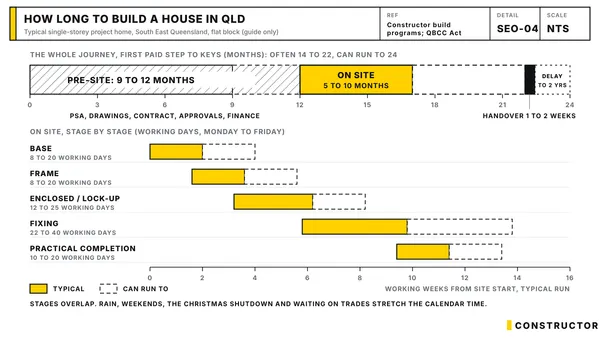
A single-storey project home typically takes 6 to 9 months from slab to handover. Two storeys, sloping blocks, custom designs and wet weather all push it out. Before that, it can take up to 12 months from the day you walk into a display centre to site start. That part depends on whether your land is registered yet, the builder's backlog, and how many new homes they start each week.
From 26 years on site
The stage people rush is the one before the pour. Everyone is excited to see the slab go down, but if the set-out, the termite protection or the slab edge is wrong, it's wrong for the life of the house. An hour with a checklist the day before the pour is worth more than any inspection after it.
Frequently asked questions
What are the progress payment stages?
Most Australian residential contracts use deposit, base (or slab), frame, lock-up (or enclosed), fixing and practical completion. The names and percentages are set in your contract, and every payment must relate to work actually done.
Do I need my own inspector if the certifier is inspecting?
The certifier or building surveyor checks the work complies with the approval and the building code at a few set stages. They don't check finish quality or what's in your contract. An independent inspector, or a stage checklist, covers what the certifier doesn't.
When should I inspect?
Before you pay each stage claim: before the slab pour, at frame, at lock-up, at fixing, at practical completion, and again at 6 months.
What is practical completion?
The point where the house is finished to the contract and drawings except for minor defects that don't stop you using it. It triggers the final payment and starts the defects period.
The checklists for each stage
Every stage above has a Constructor checklist that walks you through what to look at before you pay. Start with the free C1 land checklist, or get every stage in the Complete Set. Use them alongside your inspector, not instead of one.