

It's Tuesday 27 January, and we're chipping away at concrete. Today was all about demolition, setting up site security, and making the site container feel a bit more like home.
Breaking ground (and concrete)
The big job today was more concrete demolition. The team from Nyanda used a 3-tonne excavator to chip away at the thick edge beams, while a 25-tonne excavator with a ripper tried to pull sections up. The ripper couldn't lift them. Some of this concrete is seriously thick.
The excavators have a few attachments on site: a grab for picking material apart, buckets of different sizes, a sieve bucket for sifting rubble out of the sand, and a pulveriser with jaws that crush concrete.
Reading the old slab
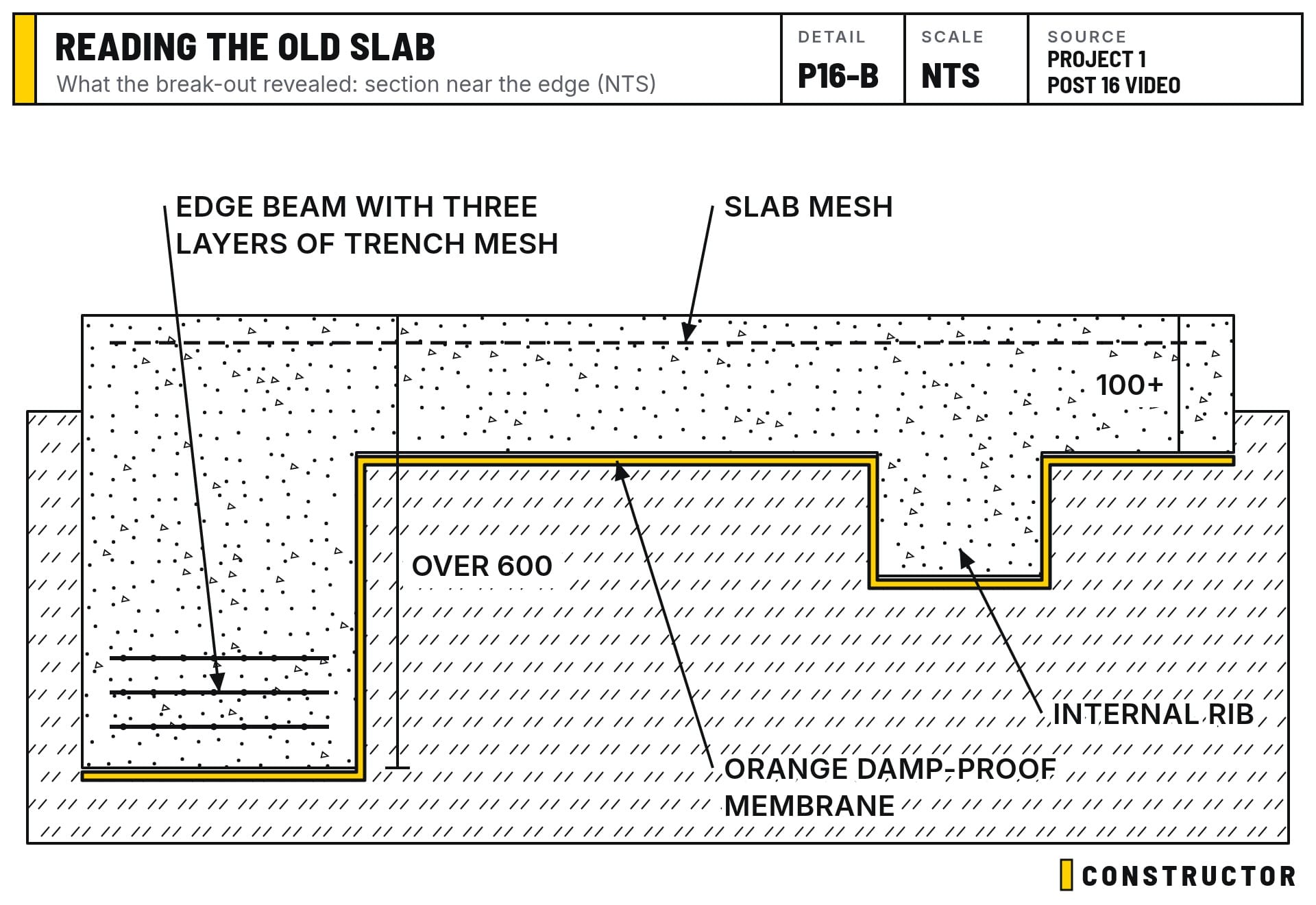
Breaking out an old slab is a good chance to see how it was built.
- The slab itself is over 100 mm thick, with mesh near the top.
- The edge beams around the outside were supposed to be about 600 mm deep. They turned out deeper than that. You can tell an edge beam because it has trench mesh in it: three layers of welded reinforcement down the beam.
- The internal ribs are thickened strips of concrete under the slab that stiffen it, like the beams in a raft slab.
- The orange layer underneath is the damp-proof membrane, which stops ground moisture rising into the slab.
Tomorrow a ring saw (concrete cutter) arrives. Ring saws can cut right up to an edge, so it will cut through the slab and reinforcement near the rear stairs and along the neighbour's side. Then the 25-tonne excavator can peel everything out more cleanly. In theory.
The crew have also pulled the concrete capping off the old revetment wall (the seawall at the back). Nothing was pinned into it, and you can see it's keyed in, which we'll keep.
Building our security system
One of the most exciting jobs for me is the site security. Instead of paying for a temporary monitoring service, we're building our own system that we can later integrate into the finished house.
Whether that makes sense depends on how long your project runs and your budget. The big risks on a site are theft (copper cable and pipe are prime targets with copper prices at record highs), vandalism, and keeping track of deliveries and who's on site.
Two 8-metre steel posts arrived: 75 x 75 mm square hollow section, 4 mm thick, in Duragal (a galvanised coating). We'll weld plates on and mount two UniFi G6 Bullet cameras on each post.
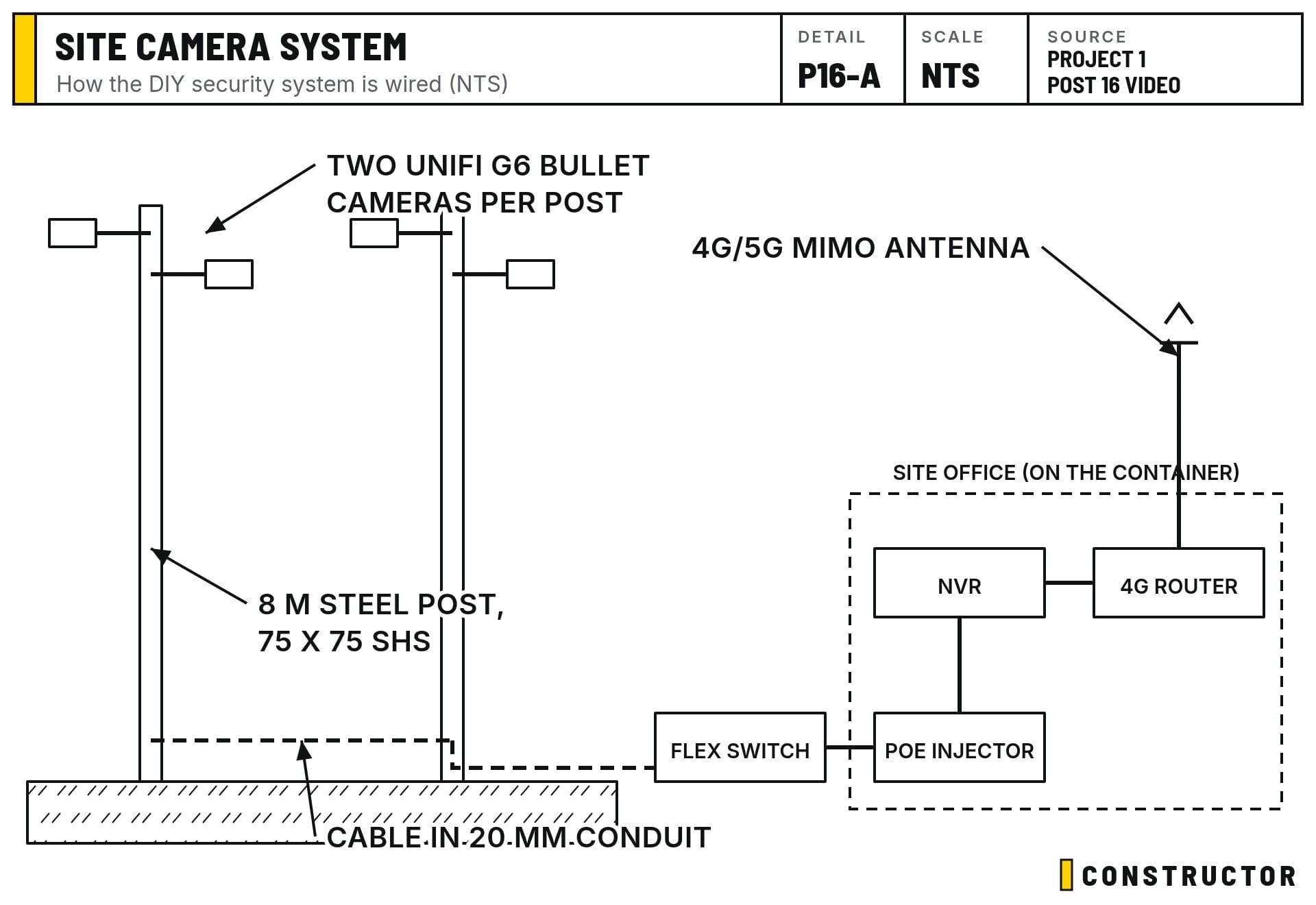
Here's how it fits together:
- Cameras. The cables run through 20 mm conduit into junction boxes with weatherproof RJ45 joiners.
- Switch. They come back to a UniFi Flex switch with four PoE ports. PoE (power over Ethernet) means one network cable carries both data and power to each camera. A 60-watt PoE injector powers the switch.
- Recorder. The switch connects to the NVR (network video recorder), which will live in the site office on top of the container, with spare ports for the office computers.
- Internet. A tiny Teltonika RUT241 4G router, with a 2x2 MIMO 4G/5G antenna on a pole run back by cable. That keeps the router dry inside while the antenna gets the signal.
Is DIY site security worth it?
The hardware came to $2,880, and the steel posts were $541 delivered, so about $3,400 all up. A typical site monitoring service is about $138 a week, so on a long build like ours the system pays for itself in under 8 months, and the homeowner keeps the cameras for the finished house. On a short build, a monitoring service may still be the better deal.
I'm thinking about adding two more cameras and a UniFi siren that sounds when the cameras detect someone after hours. You can see how the full system ended up in Post 18.
The container command centre
The site base is taking shape. We've got temporary power to the container for the essentials: a fridge, a microwave and, most importantly, the coffee machine. An electrician is coming to install a proper sub-board.
We unexpectedly got two electric utes on Friday, so the electrician will also fit a 32 A single-phase industrial outlet on the side of the container and make up a 6 m lead for it. The utes plug their Type 2 charger into that lead and charge in three to four hours. While he's here, every lead on site gets tested and tagged, and we keep a record. On a construction site that's repeated every three months.
We've pinned down the geofabric with tent pegs (I might have speared the soaker hose, but at least the tree's getting extra water) and plan to build a simple bench from 90x45 timber off the side of the container. It'll be a barbecue and surfboard bench, with a shady spot to cook and relax.
Next is levelling the container (no one wants to work in a slanty shanty) and building a small deck with stairs at the back for easier access. We're still waiting on the site office to be delivered.
The running joke is that we should cut a window in the container, prop up the awning and sell $2 hot dogs to the neighbourhood. A pop-up site café might be our next side business.
Looking ahead
Tomorrow the ring saw is the main event. We're also working through a challenge with the boundary wall. We'd like to rebuild it in Dincel, but the neighbour has power and water running through part of it, so we need to sort that out first.
That's the wrap for today: heavy demolition, tech setup, and making site life work. Every day the site gets a little more cleared, a little more secure and a little more organised.


