

If you're planning a basement, you've probably heard of sheet piling and secant piling. They are the most common methods of basement retention, but the process can be loud, stressful, and expensive.
And if you’re doing this in a tight residential area, it gets even trickier.
The First Big Hurdle: Fence Stress and Pre-Drilling
One of the first things we noticed was the stress we were putting on a neighbour's 40-year-old fence. It wasn't looking happy.
The reason? Pre-drilling. We had to drill down about 8 meters to make way for the sheet piles. But on this site, the groundwater is incredibly high, and the soil is sandy. Pre-drilling reduces the soil cohesion and the loose sand fills in the voids left from the pre-drilling process.
So, when the drill auger comes up, the hole fills back in. The sand and water come back in, essentially undermining the ground right next to the fence. Because the fence’s footing isn't that deep (it's just a standard fence, not a structural wall), it didn't have enough support pushing up against it.
The result? It started to sag, twist, and drop under its own weight.
This was a major "ah-ha" moment for us. We knew some of the fence line was piered (which means it has concrete piers) in some sections but not in others.
Here's the key lesson on pre-drilling:
- Ask the hard questions: You must know if your neighbour's fences have decent footings and preferably piered footings. If not, you risk serious damage and expensive repair work.
- Get it in the quote: Many sheet piling contractors won't quote for pre-drilling. They'll just quote to push the piles in, hope it works, and if it bends or breaks, they'll come back with a variation. That's a pain for contract administration and client expectations and the project budget.
- Select your contractor: Our contractor included pre-drilling in their original quote. It's a huge piece of mind to have that as a one-stop solution, even if there are still variations for latent conditions.
Because the fence was a but unhappy in places (due to shallow or non existent footings), we had to build a small platform and prepare for a controlled demolition. It's all part of the process, but it's a good reminder that site prep involves more than just the hole you're digging.
Vibration: The Real Conversation with Your Neighbours
Let's talk about the vibrating elephant in the room: vibration.
Note: DIN4150-3 is the main standard of reference for configuring vibration monitoring devices.
Sheet piling is often associated with vibration. And we were worried about it. So, we invested in our own vibration monitors.
Convergence Instruments is the name of the company who make the devices we purchased


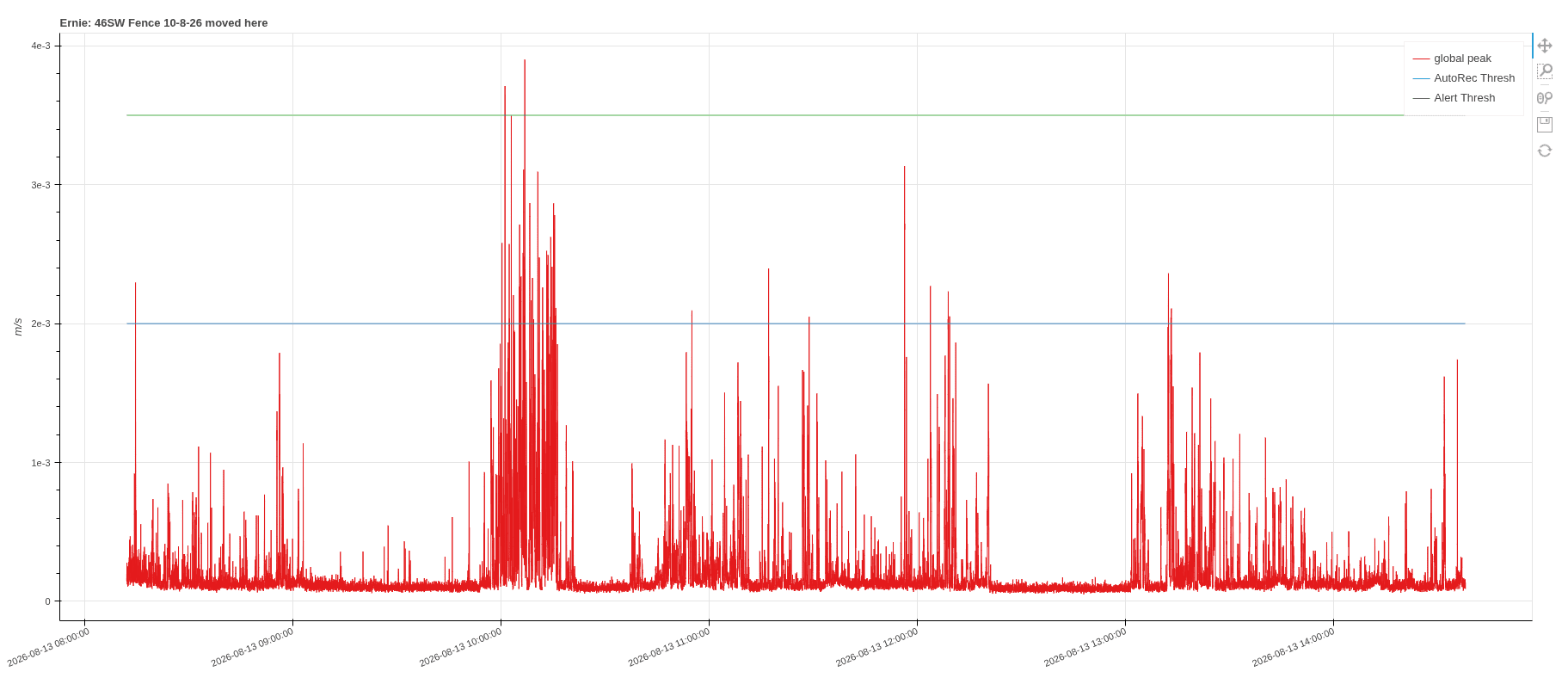
These little devices (which cost about $1,000 each) are worth their weight in gold. They measure movement on three axes (X, Y, and Z), upload data to the cloud in real-time, and allow us to keep a record of exactly what's happening.
Here’s what we learned on this project about managing vibration:
- The big machine made a difference: We used a large drill rig to push the sheets in, rather than just hammering them. We only used the vibrating attachment for the last meter or so of each pile.
- Numbers matter: The average vibration we saw was around 3.5 millimeters per second. For context, heritage-listed buildings have a guideline of 3 to 8 mm/s, and standard vibration management plans allow for 15 to 20 mm/s.
- The drill rig tracking was the worst part: Interestingly, the biggest vibration spikes (up to 9 mm/s) didn't come from driving the piles. They came from the heavy machinery tracking across the ground.
We also had our geotech install and monitor their own vibration data collection devices. Why? Because if a dispute ever arose, we wanted "the expert" to be the one placing and reading the equipment. Otherwise, someone might argue that we, as non-licensed geotechnical engineers, could have installed our devices incorrectly.
That said, we didn't just rely on them. We spent time—and a video call—with the device manufacturer (convergence instruments) to set up and configure our own devices properly. We wanted to make sure the real-time data we were seeing through the cloud software was accurate. No false positives. No weird readings. We wanted to make sure we could trust the data.
The Cost Comparison: Sheet Piling vs. Secant Piles
You have options when it comes to retaining walls, but they come with different price tags.
We briefly considered secant piles for this job. Here's the breakdown:
- Secant piles: These are large concrete piers drilled into the ground that interlock. They create an almost waterproof wall and produce almost zero vibration. The catch? They cost about $330,000 more for this project and take up more space.
- Sheet piling: This is what we used. It’s steel sheets driven into the ground. It’s faster, cheaper, and lighter. The catch? It can vibrate, and it's technically a temporary retaining system (designed to corrode out slowly).
- The choice was clear. For this project, saving over $300,000 and preserving space in the basement was the right decision. It’s a great reminder that, while the most expensive option is often the quietest, you can manage the downsides of a less expensive option with good planning.
Keeping the Neighbours Happy (as much as you can)
Beyond the money and the machinery, a huge part of this project is about people.
The noise during sheet piling was a concern. We measured the sound at a maximum of about 86 decibels.
It's loud, but for a construction site, it's not over the top. However, the worst part for everyone (including the crew) wasn't the sound. It was the diesel exhaust from the drill rig.
We tried to be considerate. We checked the tree health and had an arborist give us a management plan because we wanted to protect the vegetation. We even cut back a palm tree with a cherry picker so we could avoid having the drill rig head and augur entanglement with the palm tree fronds.
Moving forward, we’re setting up a shared calendar with the neighbours. We'll let them know about upcoming deliveries, concrete pumping, and other noisy activities. Constant rain has made scheduling difficult, but being proactive and transparent is going to make a big difference for everyone involved.
The Retention is done: It’s In the Ground
The most difficult phase is over. The sheet piling is in, and the big machines are being picked up. From here on out, it’s generally smaller machines and less disruptive work.
The sheet piling installation went well. We even did an experiment with a bentonite-water mix near the end, and it made a huge difference in reducing friction. Just remember you'll have to deal with dissipating the bentonite later!
If you're planning a project like this, remember to:
- Ensure pre-drilling in your quote to avoid post contract variations.
- Monitor vibration closely so you can prove you’re within limits.
- Communicate early and often with your neighbors.
It wasn't always easy, but the worst of vibration activities is now behind us, and the site is ready for the next stage.
If you're reviewing a quote and something feels "off," here's a concept that could save you thousands: reasonably foreseeable costs.
Under Australian construction law, a builder is generally not entitled to recover money for variations made necessary by circumstances that could have been reasonably foreseen at the time the contract was signed . In other words, the builder is the expert. They're the ones selling the service. They're in the best position to anticipate the risks.
So, do your part. Disclose everything you know about your site conditions in writing. Give them every report, every test result, every detail you are aware of.
After that, the ball's in their court. Based on their experience and profession, they need to account for all reasonably foreseeable costs in their quote.
The smart way to handle uncertainty?
Provisional sums and prime cost items.
By including a provisional sum for something like "rock excavation," the contractor is effectively saying: "We think you might need this. We're flagging it now, and here's our best estimate of what it'll cost."
Is this ideal? No. It means the final price isn't locked in. But it's a hell of a lot better than the alternative: a contractor who says nothing, gets the contract signed, and then casually drops a $25,000 "rock removal" variation on you. Because they knew rock was a possibility? That's on them . But trying to prove it after the fact means lawyers, and legal letters, and a whole lot of stress.
Here's my strong recommendation:
Ask every question in writing before the contract is signed. Seek clarity. Never assume the contractor is on the same page as you.
Why Builders Hate PS and PC Items
Here's the thing—most residential builders don't like using provisional sums and prime cost items.
Why? Two reasons.
First, it "inflates" their quote. If you're comparing three builders, and one has a $50,000 provisional sum for rock excavation while the other two have buried that risk in a lump sum, the first builder looks more expensive. Even though they're being more transparent.
Second, they think the admin is a pain. Adjusting PS and PC items after the fact means paperwork, reconciliation, and more back-and-forth. Some builders just can't be bothered.
Here's the brutal truth: that's ignorance. Pure and simple.
By not detailing PS and PC items upfront, they're not doing you a favour—they're setting you up for a nasty surprise. And they're exposing themselves to claims that costs were reasonably foreseeable.
Because if they knew rock was a possibility and didn't tell you? That's on them.
So, push back. Ask them to break it down. If they refuse, ask yourself why. Because a builder who's scared to put numbers on paper is a builder who's probably planning to find those numbers later—when you can't say no.


