

Earlier this week the plumber and electrician walked the site with us to get familiar with it and plan the temporary services we'll need.
Temporary power comes first
Nothing happens on a building site without power, so temporary power is one of the first things we set up. Our plan is to run services along this wall, all the way to the back of the property.
It starts at the temporary meter box we marked out in Post 2. From there it feeds a temporary DB (distribution board: the switchboard with the circuit breakers and safety switches that everything plugs back to). As the building goes up, we'll add sub-boards (smaller boards fed from the main one) on each new level.
The jump-up strategy
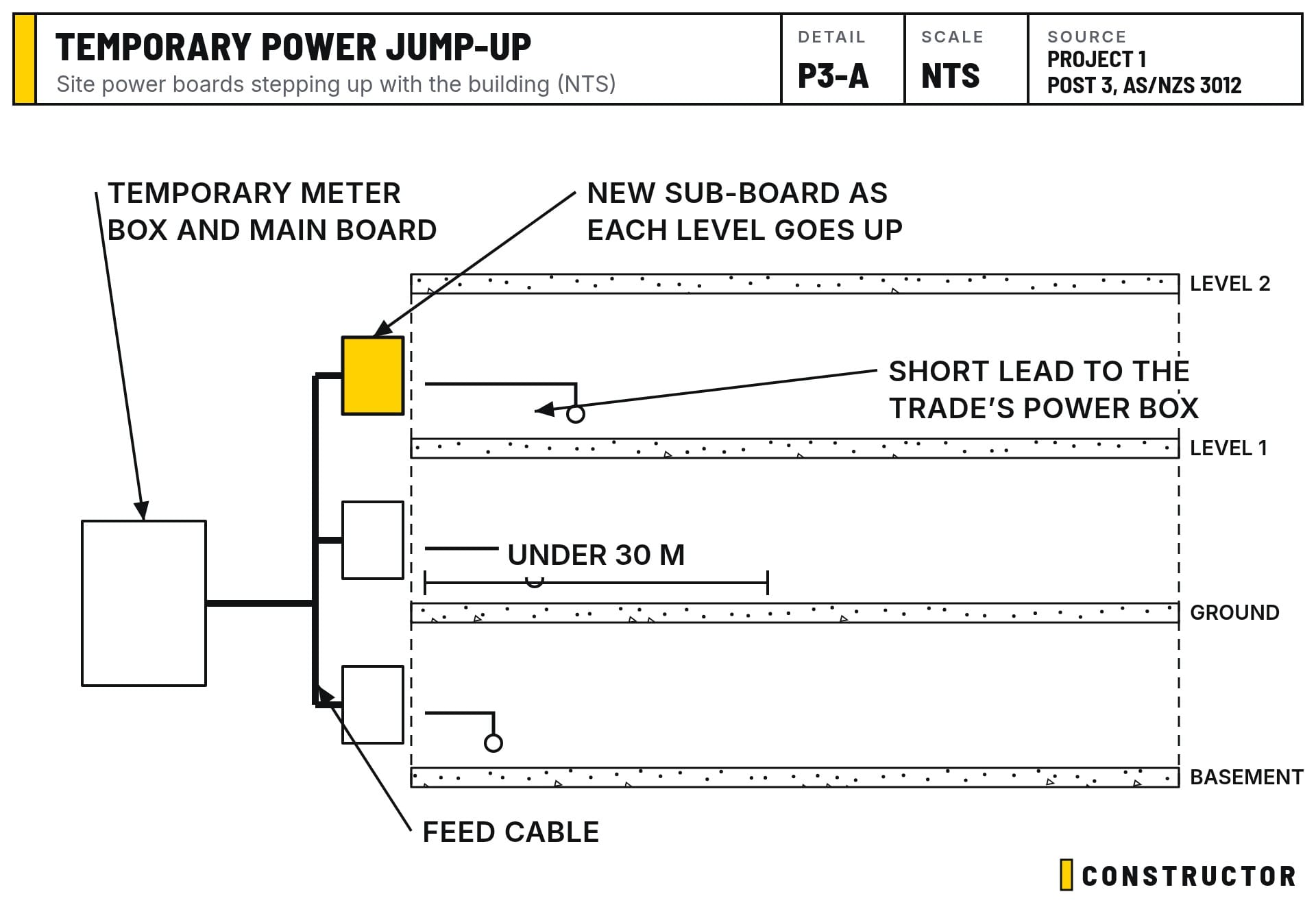
This jump-up approach keeps power lead runs under 30 metres. Maximum lead lengths depend on the cord size and rating under AS/NZS 3012, the standard for electrical installations on construction sites (for example, 25 m for a standard 10 A lead with 1.0 mm² cores). Short runs keep everyone inside those limits.
It also means trades can plug their power boxes in close to where they're working. There are no long leads lying across the ground or hanging off scaffold, where they get damaged and become trip and shock hazards, and no single board gets overloaded.
Safety switches and test tags
Every circuit on a construction site board has to be protected by a safety switch (an RCD), which cuts the power in a fraction of a second if current starts leaking to earth, for example through a damaged lead and a person.
Leads, power boxes and tools get inspected, tested and tagged too. On a construction site that's every three months under AS/NZS 3012, which is more often than an office or workshop, because site gear takes a beating. The tag shows who tested it and when the next test is due. If a lead has no tag, or the tag is out of date, it doesn't get plugged in.
Charging the electric utes
The plan also runs temporary power across the fence. That lets us set up dedicated power points for the electric utes on the driveway, so they can charge while they're on site. You can see the utes in Post 4, and the 32 A charging outlet we added later in Post 16.
Why it matters for your build
Ask your builder how temporary power and safety switches are managed on your site, and who tests and tags the leads. Every lead and power tool on a building site should carry a current tag.


