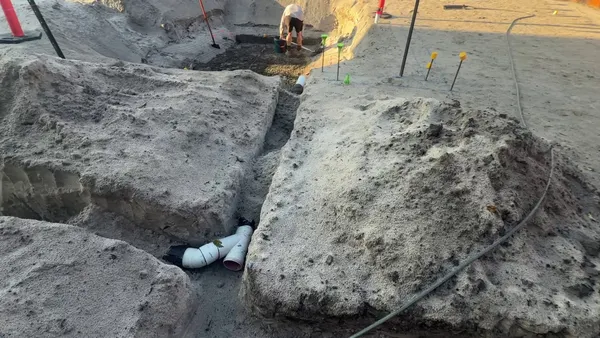
Good morning. We're still working through the dewatering installation and commissioning. The whole system is set up, and now it's water testing. This update is a walk through the treatment plant, because there's a lot more to it than a pump and a hose.
Testing before anything goes in the canal
The system is now treating water and pumping it into a test pit. Samples come out of the outlet and go to a lab. Until the results show the water is within the acceptable limits, nothing gets discharged into the canal. Once it passes, the dewatering gets turned on permanently and starts drawing the groundwater down.
Then we need about two days of drawdown before digging. The water table has to drop, and enough moisture has to come out of the ground, so the soil we cart away isn't sloppy. Otherwise it's like throwing soup in a truck: it slops out on the road and makes a mess. You can see it in the test hole, and the bottom of the basement is still about 600 mm deeper than that. From the top of the sheet piles, it's 2.4 m down to the underside of the blinding layer, which is our lowest point apart from the small sewer and stormwater pits.
We'd had the 14-tonne excavator taken off site, then brought it back, because the commissioning dates kept moving.
How the treatment plant works
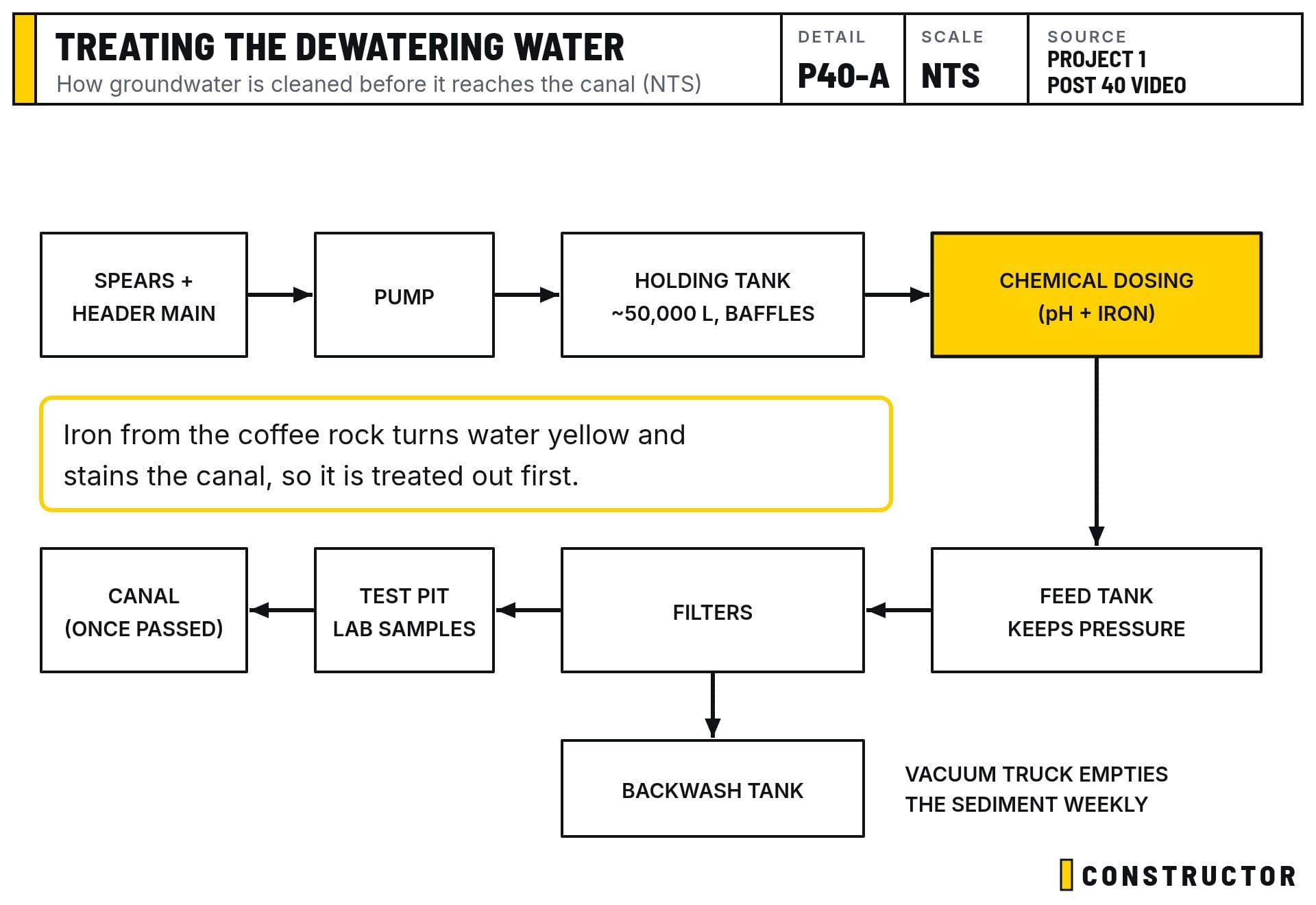
- Pump. The electric pump pulls the water through the spears and header main. It makes the noise, but it's not super loud, because it's electric.
- Holding tank. The water goes into a big holding tank, roughly 50,000 litres, a bit bigger than a 20-foot shipping container. Baffles inside slow the water down so the sediment can settle out.
- Chemical dosing. On top sits the treatment tank, with the chemicals stored and dosed into the system, starting with 500 litres of sodium hydroxide to adjust the pH. Think of it as a big pool filter: the crew is balancing the dosing so the water coming out is within the limits.
- Feed tank. A feed tank keeps positive pressure on the filters, because the pump on its own isn't big enough to push the water through.
- Filters. A bank of filters strips out what's left.
- Backwash. When the filters are cleaned, the backwash goes into a backwash tank. A vacuum truck with a telescopic arm comes once a week to suck out the sediment.
It took about four to five days after delivery to connect it all, pressure test it, and chase down leaks until the system held pressure. For now, the outlet runs into the test pit. Once the water quality is confirmed, it gets redirected to the council stormwater outlet, with hoarding put up around it.
Why iron matters on this site
There's coffee rock under this site. That's a dark, iron-rich layer that's common in coastal Queensland sand. It puts iron and aluminium into the groundwater. Iron is what turns water yellow-orange. Pump it into the canal untreated and it stains everything, which becomes a big problem quickly. So this site needs iron treatment tanks on top of the standard plant.
The extra tanks meant extra power. We'd originally provided one 32 A four-pin outlet and two standard 10 A outlets. With the iron tanks, the dewatering company needed a second 32 A outlet. Our electrician came out the next day with no notice to add the circuit. Thank you.
Doing it the right way
This is the only professional way to dewater a basement, and it's expensive. The standard system is about $8,000 a week. This site also needs heavy metal (iron) treatment, and once you add the extra chemicals and the weekly vacuum trucks, it comes to roughly $20,000 a week. The hire has a 16-week minimum, with installation and removal included in the price. Chemical use is highest at the start, because the groundwater has been sitting there concentrated for a long time. As the drawdown continues, the water quality improves and the chemical costs should taper off.
Weekly testing is part of it too. Development approvals usually require reports to council showing the water quality meets the limits. Those come from the water lab and the dewatering contractor.
What gets frustrating as a builder isn't that there are a lot of rules. It's that some people choose which rules they follow. When others skip steps on similar projects, it saves them money, right up until they have a problem, and then the problem compounds. Doing it properly is easier, there are fewer issues, and you sleep better at night. And if a contractor isn't keeping you fully in the loop, check what you're being told. We phone a lot of friends in the industry.
Getting ready for the dig
The big excavator from the dewatering and sheet piling contractors is leaving site. The smaller one stays for about two more days of bulk dig. After that comes the detailed excavation. The sheet pile pans have to be hand cleaned down to the full 2.4 m depth, because the slab is poured hard up against the sheet piling, and any soil left there causes problems. We'll bring in day labour for that.
The basement slab has to be poured as one hydrostatic slab, so we can't leave a ramp of soil to drive in on. Once it's dug out, everything will have to be craned in for the blinding, reinforcement and slab.
The concreter is coming to go through his quote. There's a lot of steel in this job, pretty much commercial-level: top and bottom layers in both directions and ligatures everywhere. The stormwater and sewer tank bases, being the deepest points, get poured first. The walls go on top, are waterproofed and tied into the slab. With a secure cover, they'll double as storage and somewhere to stand while the main slab is finished in sections.
A budget acoustic enclosure
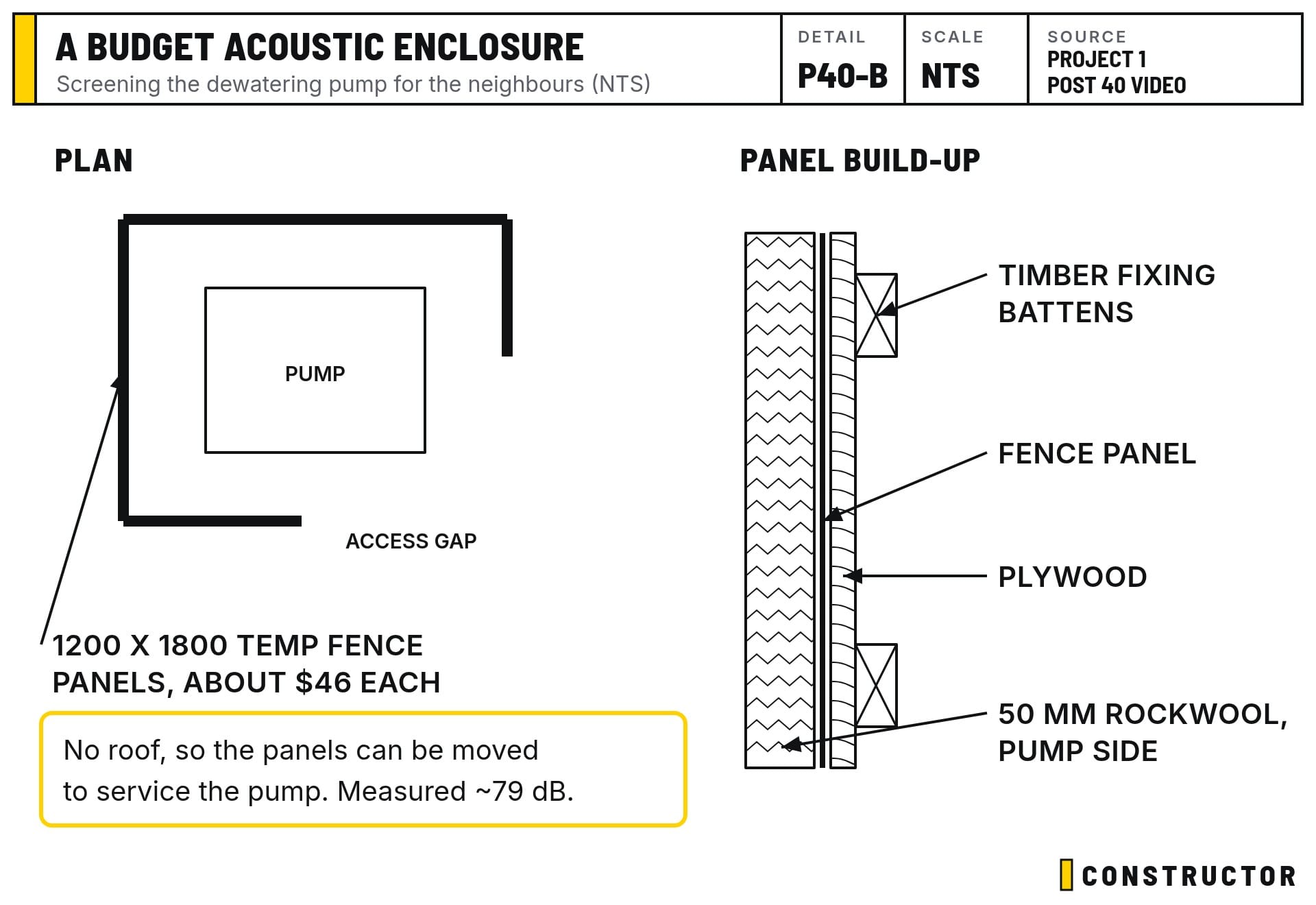
The pump will run day and night for the next six to nine months. We measured it at about 79 dB, which isn't extreme. The problem is a persistent background noise on a still night, when the neighbours are trying to sleep.
Proper civil acoustic panels were expensive, so we're building our own. We're using 1,200 x 1,800 temporary fence panels at about $46 each, with plywood screwed to the back, timber battens as fixing points and 50 mm rockwool on the pump side. At this stage the plan was no roof, with a gap at the front so the panels could be moved to service the pump.
The short version
The dewatering is installed and the treated water is being tested. Once it passes, pumping starts for real, and the bulk dig is due next week.