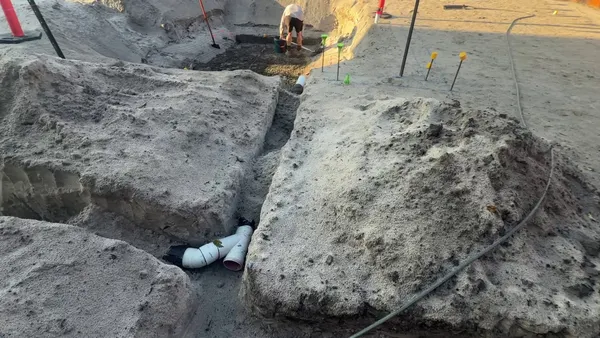
Good morning. The last update covered the spears going in. Now the rest of the system is connected, which makes it a lot easier to see how dewatering works.
Shuffling the site again
The site gets rearranged a lot, and it will keep happening. The barbecue is going, since we're not using it. In its place goes the blue external hazardous chemicals cabinet. It'll sit up on some timber off the ground and be pinned back to the structure so it can't fall over.
All the handrailing is back up, which keeps people out of the dig. For now, we've blocked off the temporary access.
The header main
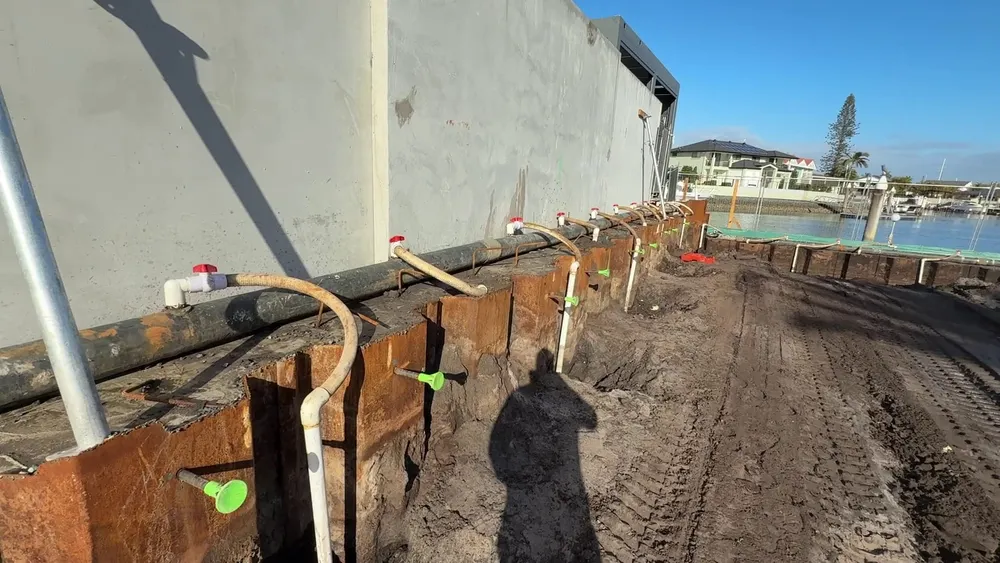
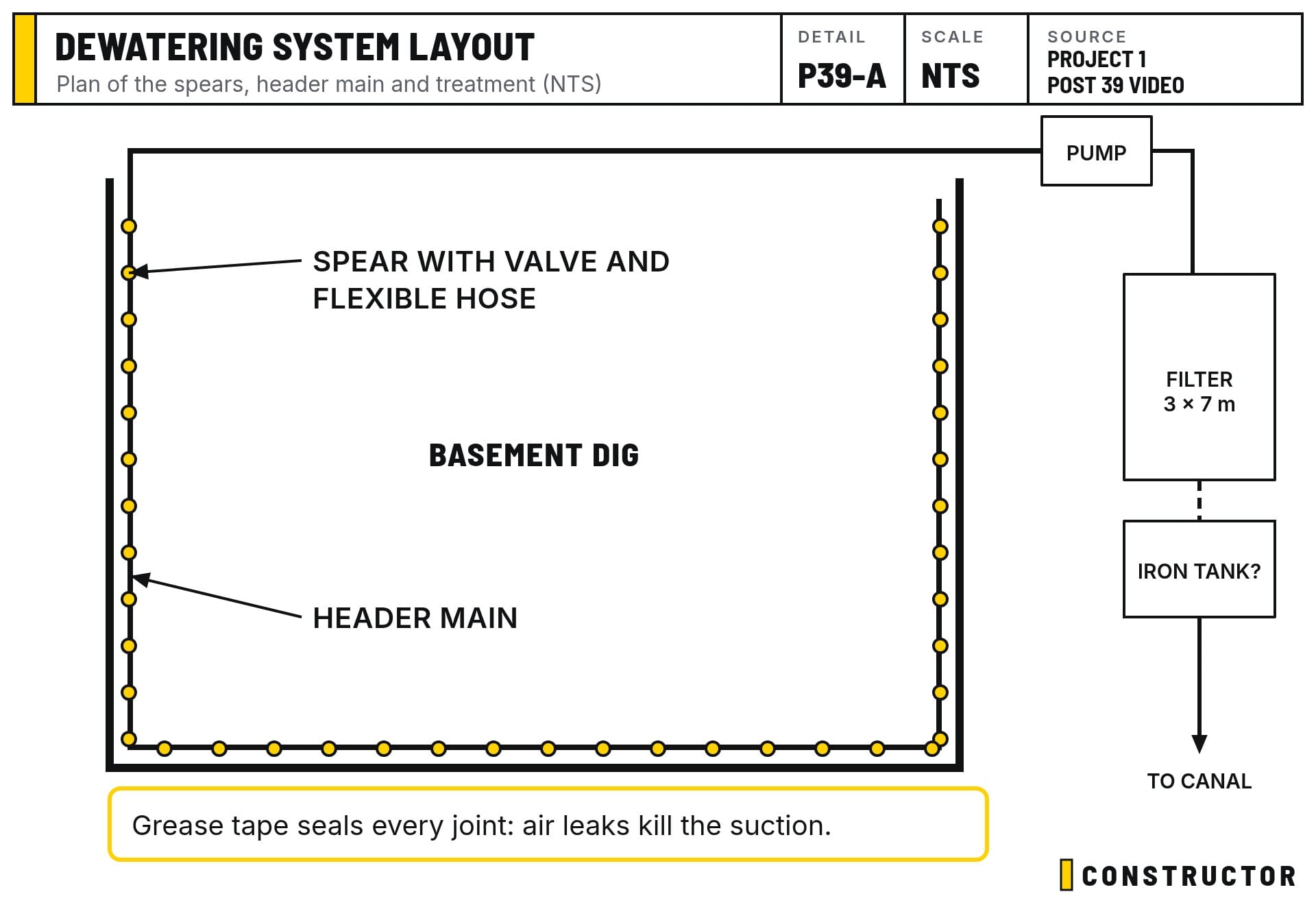
The path we built for the owner down to the boat turned out to be a great level base for the dewatering header main, the big black pipe. It's now installed right around the site.
Each spear connects to the header through a short flexible hose with its own valve, so the crew can adjust the suction in different areas. The spears go down about 6 m, with some on the inside face of the sheet piling and some on the outside. The header runs in a big U around the site, down one side and back up the other, and it's capped at the end.
Every joint is wrapped in grease tape, which is exactly what it sounds like: tape full of grease. The pump works by suction, so the whole system has to be airtight. Any air leak means less water pulled out of the ground.
Once everything was connected, the crew dug a pump-out pit with a bund around it. They primed the system, started pumping, and flushed it into the pit to clear out as much sediment as they could.
The water test decides the treatment
A water sample was taken on Tuesday, and we're waiting on the results. Those results decide what filtration equipment we need, because the water has to be treated back within limits before it goes into the canal.
- General treatment. If the water only needs the standard treatment, a 3 x 7 m filtration unit goes in, and vacuum trucks come regularly to suck out the sediment.
- Iron treatment. If there's iron in the water, an extra iron treatment tank is needed. It would go on the lawn, connected to the filtration unit.
We're hoping there's no iron. It's more treatment, more tanks, and we're running out of room for things.
A second sediment curtain
The sediment curtain at the back is working very well, and you can see the difference between the water inside it and outside. It currently runs around the stormwater main. We've ordered a second one to join on and extend the loop right around the site. They're about $1,200 each, so roughly $2,500 all up, but they protect the waterway and its inhabitants. That includes the curious one in the video, who comes over expecting to be fed.
Movement so far
There's been no more movement on the sheet piling yet. We expect some once the rest of the excavation comes out, down to the underside of the slab about 2.4 m below. Taking that soil out relieves the pressure on the inside face, and the sheets will want to move.
We don't mind the sheets moving, as long as the footing and the fence stay put. That's what the pins in Post 38 are for: after the engineer's site inspection, we used the sheet piling as a retaining wall to support the boundary footing.
What the boundary will look like when it's finished
Once dewatering is running, the next steps are the bulk and detailed excavation. Detailed means all the soil has to be cleaned out of the sheet pile pans by hand, scraped back and pressure cleaned.
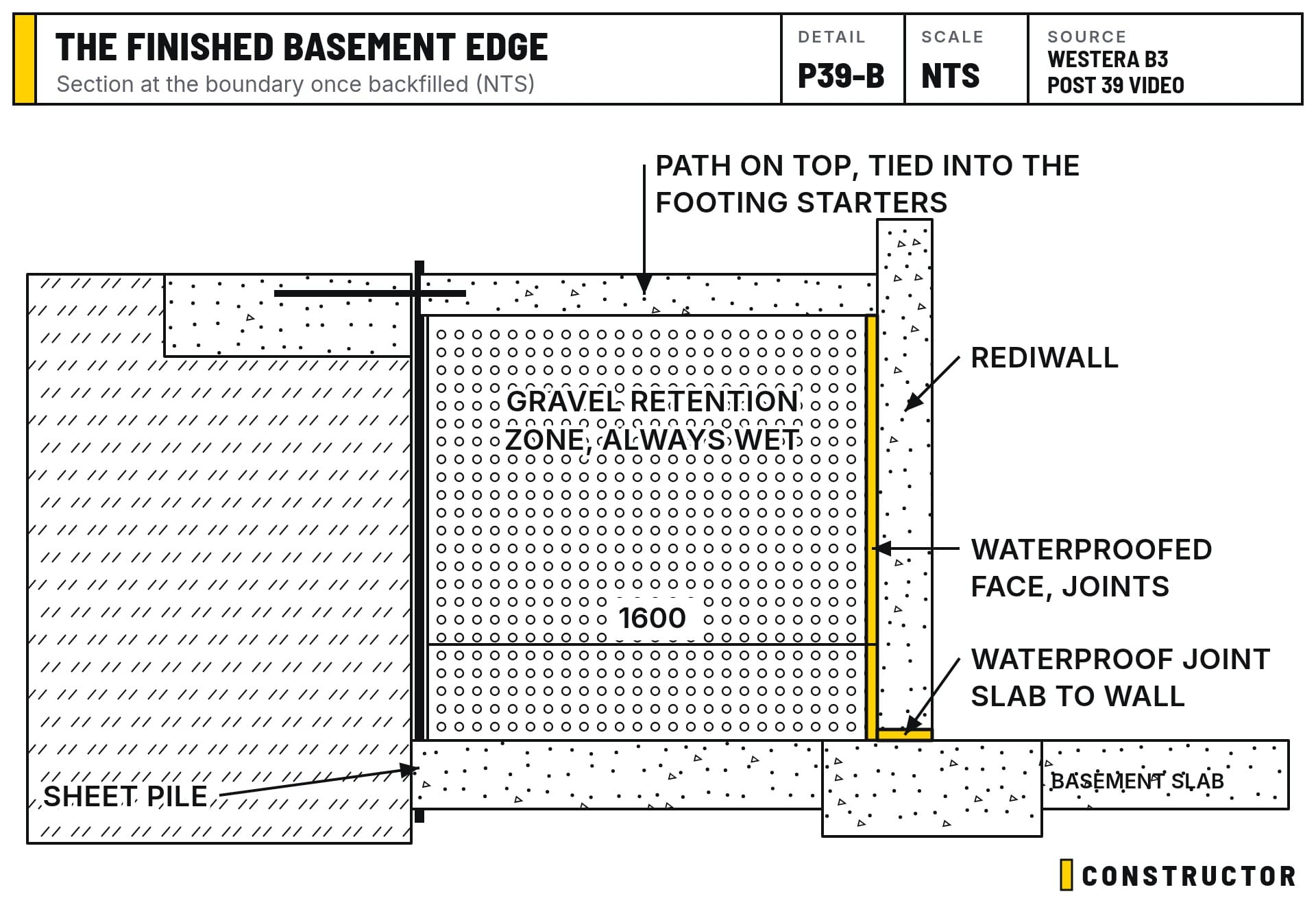
None of that will be seen in the end. Between the sheet piling and the basement wall is a retention zone about 1,600 mm wide. It gets filled with gravel, and a concrete path goes over the top, tying into the starter bars in the boundary footing.
The basement wall itself will be AFS Rediwall: PVC permanent formwork filled with concrete. The slab runs through to the wall, there's a waterproof joint between them, and we'll waterproof every vertical Rediwall joint as well. Strictly it doesn't need it, but this wall will be permanently wet. It's a hydrostatic wall, and once it's backfilled with a path on top, it's very hard to get at. You can treat a leak from the inside face, but the best approach is to make sure you never have to.
The short version
The dewatering is installed and sealed, and we're waiting on the water test. Then the filtration plant arrives, pumping starts properly, and we can get on with the dig.