Building a house isn't like buying one. You don't settle once and get the keys. Your builder is paid in stages as the house goes up, and if you're borrowing, each payment comes out of your construction loan after a set of checks.
Most people don't think about how that works until the first progress claim lands in their inbox. By then it's easy to get caught between a builder who wants paying and a bank that isn't ready. Here's how progress payments and bank drawdowns work, and what to check at each stage.
C7 - Frame Stage Inspection Checklist
$119.00 AUD
Last updated 28 Oct 2026 · Revision 5 · Free updates for life
Checklist Type: Major (Frame Stage)
Form Factor: Fillable, print-ready PDF (A4, 48 pages)
When to use: Frame stage: after the frame and trusses are up, before linings go in
A 146-point frame stage checklist. Check walls, openings, trusses, bracing and tie-downs against your drawings before the linings go in, while changes are still simple.
How a construction loan differs from a home loan
A normal home loan pays the full amount at settlement. A construction loan releases the money in stages, as the house is built.
- You draw down progressively. The lender pays each stage as it's claimed and checked.
- You pay interest on what's been drawn, not the full loan amount. During construction, repayments are usually interest-only.
- It switches at the end. Once the house is finished, the loan usually moves to principal-and-interest repayments.
If you're also buying land, that's usually a separate loan or a first stage, settled before construction starts.
The stages you'll pay
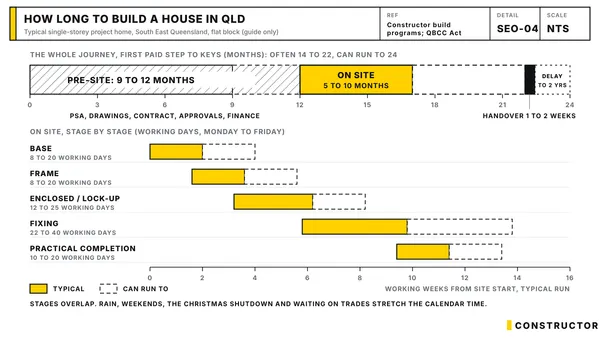
Your building contract sets out the payment stages. A typical Queensland new-home contract looks something like this, but check your own schedule line by line.
- Deposit. On signing. Capped by law at 5% for contracts of $20,000 or more.
- Base. Slab poured, or floor frame done.
- Frame. Wall and roof frames up and inspected.
- Enclosed (lock-up). Roof, external walls, windows and external doors in.
- Fixing. Linings, cabinets, internal doors and trim.
- Practical completion. Finished and ready to hand over.
Under Schedule 1B of the QBCC Act, every claim after the deposit must relate directly to the progress of work on your site, and be proportionate to the value of that work, or less. Watch for schedules that front-load the early stages. My guide to progress claims goes into more detail.
How a drawdown works, step by step
Each stage usually follows the same pattern.
- The builder issues a progress claim for a completed stage.
- You check the stage is actually complete, as your contract defines it.
- You sign the lender's drawdown or progress payment form and send it with the claim.
- The lender may send a valuer to confirm the stage is done. Some lenders inspect every stage. Others rely on the claim and photos for early stages.
- The lender pays the builder directly from your loan.
This takes time. Your contract sets how many days you have to pay a claim, so find out your lender's turnaround before the first claim arrives. If the two don't fit, you can end up in breach of the building contract through no fault of your own.
The bank's valuer is not your inspector
This is the misunderstanding I see most. The valuer works for the lender, not you.
A stage valuation checks that the work claimed is there and that the loan still covers the cost to finish. It doesn't check whether the frame is braced properly, whether the waterproofing is right or whether the slab was poured to the engineer's design.
So before you sign any drawdown form:
- Walk the site, or have your independent inspector check it.
- Ask for evidence: the certifier's frame inspection, photos and any engineer's sign-off.
- Raise problems in writing before the payment is due.
Our C7 Frame Stage checklist is built for the frame claim, and C5 Pre Pour Slab covers what to check before the base stage. Once you sign that form, most of your leverage goes with the money.
Your money usually goes first
Lenders usually want your own funds spent before theirs. That means your deposit and any gap between the loan and the total cost are paid out first, often at the early stages.
Know exactly how much cash you need and when. If your contribution is sitting in a term deposit or an offset account, make sure you can reach it when the first claims arrive.
Where construction loan drawdowns go wrong
- The stages don't match. If your contract's payment schedule doesn't line up with the stages your lender will fund, claims can stall. Give your lender the contract schedule when you apply.
- A low valuation. If the valuer says the finished home will be worth less than the land plus contract price, the lender may lend less. You fund the gap.
- Variations and upgrades. Your loan was approved on the original contract price. Extras are usually paid in cash or need a loan increase. Talk to your lender before agreeing to big variations.
- A stage reported incomplete. The lender won't pay until it's done. Tell the builder in writing straight away, so the delay isn't blamed on you.
- Long delays. Many construction loans expect the build to finish within a set time. Ask what happens if it runs over.
- The final payment. The lender will usually want the final certificate, and sometimes its own inspection, before releasing the last payment. More on that in avoiding final valuation delays.
Watch for payment-redirection scams
Criminals hack email accounts and send "updated bank details" that look like they're from your builder. Before any progress payment is made:
- Confirm account details by phone, using a number you already have.
- Treat any last-minute change of bank details as suspicious.
- Tell your lender if anything looks off.
Banks rarely recover money sent to a scammer.
Before you sign the building contract
The best time to sort out your construction loan is before you commit to a builder.
- Get formal approval, or make sure the contract has a clear finance clause. Pre-approval isn't approval.
- Check the contract type. Many lenders won't fund cost-plus contracts.
- Show your lender the payment schedule and ask whether it fits their stages.
- Ask about turnaround for each drawdown and whether they inspect every stage.
- Use a broker who regularly does construction lending. The process is different from a purchase loan.
Every lender's process is different, so talk to your lender or broker about your own loan before you sign anything.
The short version
A construction loan pays your builder stage by stage, after the builder claims, you check the work and the lender confirms it. The bank's valuer checks the work exists, not that it's right, so do your own stage checks before you sign any drawdown form. Line up your contract stages with your lender's early, and keep cash aside for variations.
Get the paperwork rhythm right and progress payments become routine.
FAQs
Do I pay interest on the whole construction loan from day one?
Usually not. You pay interest on the amount drawn so far, so repayments grow as each stage is paid.
Does the bank's valuer check the quality of the work?
No. The valuer works for the lender and checks progress and value, not compliance or workmanship. Use your own inspector for that.
Who pays the builder, me or the bank?
Usually the lender pays the builder directly, once you've signed its drawdown form for each stage.
What if I want an upgrade halfway through?
Your loan was approved on the original price, so extras usually need cash or a loan increase. Speak to your lender before you sign the variation.