November home maintenance gets the house summer ready. Heat, storms and heavy air-con use all test the seals, the drains and the soil under the slab, so this month you check them before summer peaks. The checks follow the printed calendar and take about an hour.

C18 - 6 Month Maintenance Checklist
$59.00 AUD
Checklist Type: Minor
Form Factor: Fillable, print-ready PDF (A4, 19 pages) with a maintenance calendar and log
When to use: After handover: your first six months and ongoing home maintenance
A 110-point home maintenance checklist with a calendar and log. Plan preventative maintenance, find small problems early and keep your warranties in good order.
✓ Authorship verified on the blockchain · View certificate
This month's checks
1Check the windows, doors and locks

Summer storms drive rain at windows and doors. A tired seal or a door that won't latch lets water and heat in, and a sticking door can be an early sign of movement.
- Open, close and lock every window and external door.
- Look at the seals and glazing for gaps, splits or loose beads.
- Tighten loose handles and hinge screws, and adjust strikers so doors latch firmly.
- Note any door that has started to stick or rub.
Daylight around a closed door, water on the sill after rain, or a door that suddenly binds.
Water gets in, or several doors start sticking at once. Report it to your builder in writing during the defects period, or call a licensed builder.
QBCC's Standards and Tolerances Guide treats handles, locks and latches that don't work as the maker intends as defects in the first 12 months (section 9.3). Section 9.4 sets internal door gaps of 2 to 4 mm to the frame, unless your plans say otherwise.
2Check the wet-area grout and silicone

Split silicone lets water behind the tiles. That's how the most common building defect, a leaking wet area, usually starts.
- Look closely at the silicone around showers, baths, basins and benchtops.
- Press it with a fingernail. It should be firm and stuck on both sides.
- Check the grout for cracks, holes or crumbling.
- Look for mould that won't wipe off.
Gaps, peeling or black mould in the silicone, loose tiles, or a musty smell.
Tiles are loose or drummy, or there's damp on the other side of the wall. That points to a membrane problem. Call your builder or a licensed waterproofing contractor.
QBCC's guide (section 14.1) requires wet-area waterproofing to meet the NCC and AS 3740. Section 12.6 treats missing sealants at junctions as defects in the first 12 months.
3Check air-con airflow and the condensate drain

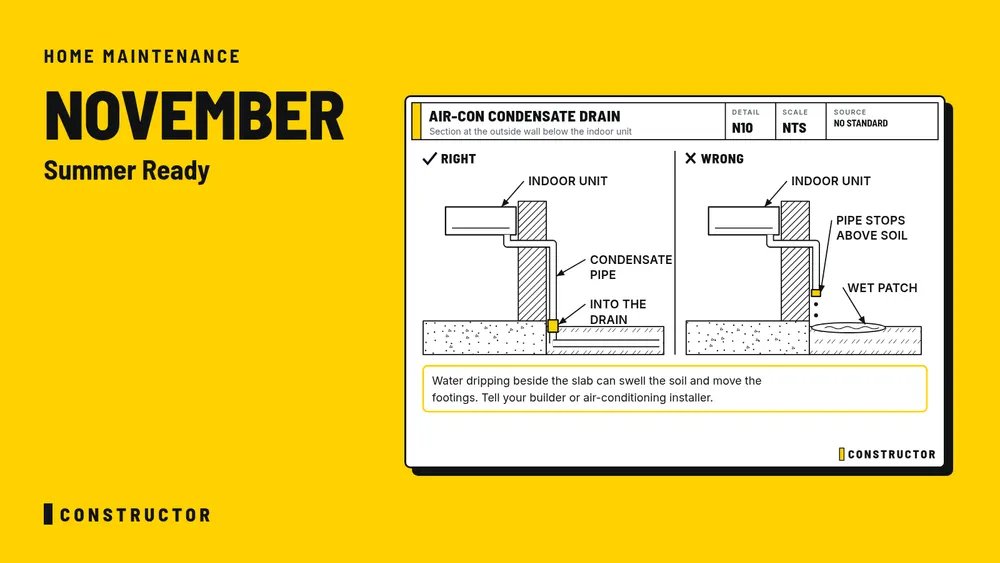
Weak airflow means a blocked filter, a crushed duct or a failing unit. A condensate drain that leaks onto the ground soaks the soil next to the footings.
- Run the system in cooling mode.
- Hold your hand under each outlet and compare the airflow between rooms.
- Go outside and find where the condensate pipe discharges.
- Check it runs to a drain, not onto the soil beside the house.
One room with weak airflow, water dripping indoors, or a wet patch next to the slab.
Airflow is poor after you've cleaned the filters, or the drain discharges onto the ground. Call a licensed air-conditioning contractor, and tell your builder or installer if it's in the defects period.
4Set a watering plan that keeps soil moisture even at the slab

On reactive clay, soil swells when wet and shrinks when dry. Drying out, or over-watering beside the slab, can move the footings and crack walls.
- Walk around the house and look for cracked, dry soil or soggy patches next to the slab.
- Set the garden watering to soak evenly, not in one spot against the wall.
- Keep sprinklers and drippers from wetting the slab edge.
- Fix leaking taps and hoses near the house.
Gaps opening between soil and slab, new cracks in walls, or doors that start sticking.
Cracks are growing. Ask a structural engineer, and tell your builder in writing.
QBCC's guide (section 3.1) says the builder isn't responsible for foundation movement caused by the owner's landscaping, trees or drainage after handover. NCC 2025 Housing Provisions 3.3.3 requires the ground to fall away from the house.
5Check the outdoor lights, sensors and doorbell
Summer storms and insects get into outdoor fittings. Working lights and sensors keep paths safe and help security.
- Walk around at dusk and check every outdoor light works.
- Walk past each sensor light and check it turns on.
- Press the doorbell, and test any alarm system as its maker says.
- Replace failed globes in fittings you can reach safely.
Water inside a light cover, flickering, scorch marks, or a sensor that stays on.
A fitting has water in it, is scorched or keeps tripping the safety switch. Call a licensed electrician.
6Check the fire blanket or extinguisher is in date
A fire blanket or extinguisher only helps if it works and you can reach it quickly. Kitchens are where it's most needed.
- Check it's mounted where you can grab it, near the kitchen exit.
- Read the label for the expiry or service date.
- If the extinguisher has a gauge, check the needle sits in the charged zone the label shows.
- Check the fire blanket's tabs are visible and the cover isn't damaged.
An expired date, a low gauge, a damaged case or a missing tag.
It's out of date or the gauge is low. Replace it, or have it serviced by a fire equipment technician as the maker says.
Where you live changes the timing
Your November home maintenance follows the weather:
- North (QLD, NT, northern WA, northern NSW). Wet season starts. Check for leaks and ponding after the first big storm.
- South (temperate areas). Hot weather starts. Water the garden evenly and keep the gutters clear.
Every month, as well
Alongside your November home maintenance, do the five monthly checks:
- Test every smoke alarm with the test button.
- Clean the air-con filters while you're using it.
- Check wet areas for mould and run the exhaust fans.
- Walk around and note new cracks, leaks, stains or sticking doors.
- Record what you did in your maintenance log.
The short version
November home maintenance checks the seals that keep water out, the air-con that keeps you cool, and the soil moisture that keeps the slab still. Our C18 6 Month Maintenance checklist covers each check. For more on drainage and slab movement, read Protecting Your Foundation with Better Drainage, and for damp wet areas, Condensation and Mould on Builds.
Next month: December home maintenance.
FAQs
Why repeat the door and silicone checks in November home maintenance?
They're six-monthly checks. Doing them before summer catches gaps before the storms and heavy showers of the wet season.
Can I redo the silicone myself?
Cutting out and replacing silicone around a shower or bath is a common owner job, if you follow the sealant maker's instructions. If tiles are loose or there's damp behind the wall, call a professional instead.
How much should I water near the slab?
There's no single figure. Keep the soil evenly moist, never soaked or bone dry, and follow your engineer's or builder's advice for your site.
What if I don't have a fire blanket or extinguisher?
Many households keep one near the kitchen. If you add one, choose a type suited to kitchen fires, follow the maker's instructions, and add its date to your maintenance log.