
December home maintenance wraps up the year. You clean the filters, make the house safe to leave for the holidays, and bring your warranty dates and maintenance log up to date. The checks follow the printed calendar and take about an hour.

C18 - 6 Month Maintenance Checklist
$59.00 AUD
Last updated 28 Oct 2026 · Revision 4 · Free updates for life
Checklist Type: Minor
Form Factor: Fillable, print-ready PDF (A4, 32 pages) with a maintenance calendar and log
When to use: After handover: your first six months and ongoing home maintenance
A 92-check walk round your home at about 6 months, with a maintenance calendar and log. Find the defects to send your builder in time, then keep your warranties in good order.
✓ Authorship verified on the blockchain · View certificate
This month's checks
1Clean the rangehood filters, dryer vent and dishwasher filter
Holiday cooking loads the rangehood with grease, and a lint-filled dryer vent is a fire risk. A clean dishwasher filter stops smells while you're away.
- Soak the rangehood filters in hot water and degreaser, or wash them in the dishwasher if the maker allows. Dry them before refitting.
- Clear the lint screen and the dryer's exhaust vent.
- Take out the dishwasher filter, rinse it and refit it.
Grease dripping from the filters, clothes slow to dry, or a dryer that runs very hot.
An appliance overheats, trips the power or stops working. Call the appliance service agent or a licensed electrician.
2Turn off the water at the main if you're going away

A burst flexi hose or a failed fitting can run for days while you're away. Turning off the main limits the damage to what's already in the pipes.
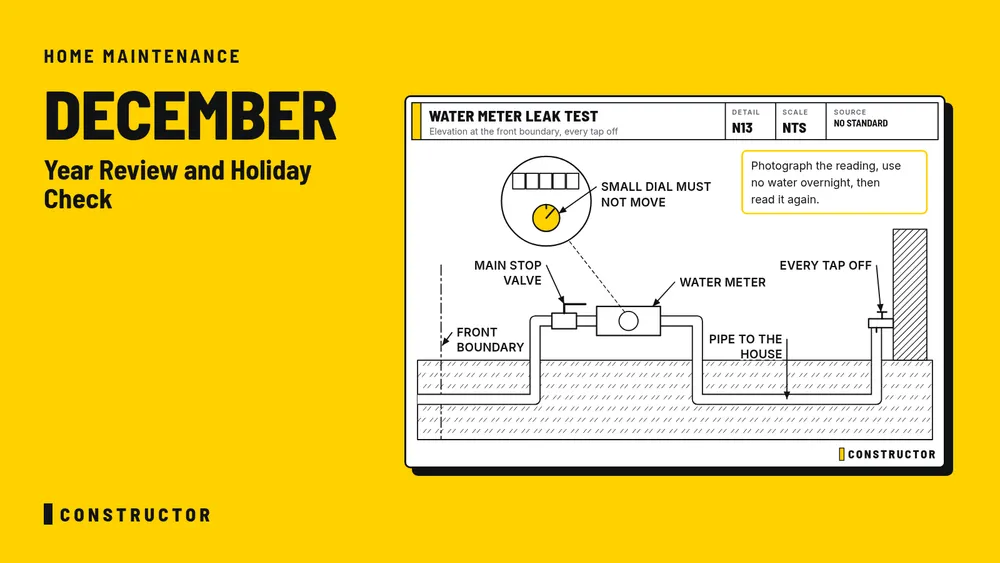
- Find the main shut-off, usually at the water meter.
- Turn it off by hand and check a tap stops running.
- Check your hot water unit's manual for what to do with it while the water is off. A water heater must never run unless it's completely full.
- Turn off any irrigation and the rainwater tank pump.
- Draw sheer curtains or blinds where strong sun hits timber floors. Sun and a house shut up for weeks can cause gaps, cupping and colour change, which may be treated as the owner's responsibility (WoodSolutions).
- Tell a neighbour and leave them a contact number.
A valve that won't turn, a meter that keeps moving with the main off, or water around the meter.
The valve is seized or leaks. Don't force it. Call a licensed plumber. If the hot water system has been drained, have a plumber refill it before the power or gas goes back on. The maker's warranty also excludes damage from very high or pulsing water pressure.
3Update your warranty list and service dates
Warranty deadlines pass quietly. Miss one and a defect or appliance repair becomes your cost.
- List each warranty with its end date: builder's defects period, home warranty, waterproofing, roof, cladding, paint, appliances, garage door, hot water, air-con, solar and the termite system.
- For each one, keep the proof of purchase, the installer's licence or compliance certificate, the handover documents and any warranty card or online registration. Many makers refuse claims without them.
- Note the claim deadlines. Some are short: 60 days to register one extended screen warranty, 30 days to report a fault on fibre-cement or hardboard cladding, 7 days for stone benchtops.
- Add the last and next service date for each serviced item.
- Put reminders in your phone before each deadline. Send your builder's defects list a few weeks before the maintenance period ends. Builders' brochures show periods of 90 days, 13 weeks, 12 months or 15 months, so check yours.
Missing paperwork, or a service that's overdue. Many extended warranties belong to the original buyer only and don't pass to a new owner.
You're unsure whether something is a defect or your maintenance. Ask your builder in writing. This isn't legal advice, so check your own contract and your state regulator's rules.
In Queensland, home warranty covers non-structural defects that appear within 6 months, and you must lodge with the QBCC within 7 months. Structural defects are covered for 6 years and 6 months. QBCC's Standards and Tolerances Guide (section 18.1) makes arranging appliance warranty service the owner's job. QBCC's home warranty disclosure covers driveways and fencing for completion only, not defects, so report those to your builder within the maintenance period.
Add these to the list.
- Waterproofing certificate. Anyone who drills, re-tiles or fits something in a wet area can void the cover if they damage the membrane.
- Roof. One QBCC roofing presentation describes pre-painted steel as typically warranted for 20 years against flaking and peeling and around 36 years against corrosion to perforation, if the owner maintains it. The tile maker recommends a roofing specialist's inspection every five to seven years.
- Cladding. Record the product and the paint system on it. Fibre-cement warranties exclude mould, paint performance, efflorescence and normal wear. Painted hardboard cladding needs a thorough paint inspection at the end of year 1 and again at year 5 (the cladding maker). Ask your builder for any foam-panel render system's warranty certificate, which one maker issues only if the installer submitted its checklist.
- Paint. The paint maker's guarantee covers the product, not how it was put on. Keep the painter's details and the paint names and colours. Textured or render finishes need a yearly check and a recoat roughly every 7 to 10 years (the render maker) or 7 to 15 years (the paint maker). On new homes and extensions, pre-primed hardboard must be top-coated within 30 or 60 days of fixing (the makers differ), and one paint maker needs a third coat for its 15-year warranty.
- Plasterboard. New plasterboard needs a sealer plus two coats (AS 2589). If you see shiny or dull bands over joints, raise it with the builder early. Note any fire-rated walls or ceilings: repairs must follow the board maker's assessed method.
- Outdoor timber and decks. Keep the paint instructions for H3 LOSP treated pine, and treat any new cut or hole with preservative and primer before painting (Timber Queensland). Let new hardwood decking weather before coating, and keep to the coating maker's minimum coats. A fibre-cement deck's 10-year warranty needs the maker's jointing system; use furniture protectors and don't leave rugs or pots that hold moisture on it.
- Solar. Have a licensed electrician inspect the system about once a year, or as the maker requires, and file the checklist. In Queensland, solar maintenance must be done by a licensed electrician.
- Carpet. Vacuum at least weekly and have it professionally steam-cleaned at least every 2 years to AS/NZS 3733. A stain-warranty claim needs the proof, and fading from long direct sun isn't covered.
- Benchtops. Engineered stone warranties exclude cracks from sudden heat, so always use a trivet. It doesn't need sealing. Don't cut or stand on it, or use oven or drain cleaners, paint strippers or undiluted bleach.
- Pool. In Queensland, pools must be registered and you need a pool safety certificate before you sell or lease. Check the CPR sign is current and visible.
4Check the smoke alarm battery and replacement dates

Smoke alarms wear out. An old alarm can fail to sound even when the test button seems to work.
- Find the date of manufacture or "replace by" date on each alarm.
- Check the label shows AS 3786-2014.
- Replace removable batteries yearly. Many newer alarms have a sealed battery instead.
- Vacuum or brush away dust and insects, and never paint over an alarm.
An alarm more than 10 years old, one that chirps, or one that doesn't sound when tested.
A hardwired alarm needs replacing. That's a job for a licensed electrician.
Queensland Fire Department advice is that alarms must be photoelectric to AS 3786-2014, interconnected, and replaced once they're more than 10 years old. Every Queensland home must comply by 1 January 2027. Hardwired alarms must be replaced with hardwired ones.
5Review your maintenance log and budget
A complete log is your evidence for warranty claims, and it adds value when you sell. Reviewing the budget shows whether you're putting enough aside.
- Read through the year's entries: what was done, when, by whom and the cost.
- Attach receipts, photos and service reports.
- Total what you spent on maintenance this year.
- Compare it with a yearly budget. A common rule of thumb is about 1% of the home's value a year, but your figure may differ.
- Note any jobs carried over to next year.
- Plan bigger jobs that fall due, such as recoating textured walls or a professional roof inspection.
Gaps in the log, missing receipts, or repeat repairs to the same item.
The same problem keeps coming back. Get the right trade to find the cause, not just fix the symptom. If you're planning new gutters, downpipes or roof attachments, tell the licensed roof plumber what the roof is made of. Water off coated or pre-painted steel shouldn't drain into plain galvanised gutters, and stainless fasteners shouldn't go on standard pre-painted steel (the steel maker's manual).
6Write next year's start month on a new calendar
The calendar works because it's a habit. Starting a fresh one keeps the checks on track and your log in order.
- Write your start month at the top of the new calendar.
- Set phone reminders for each month's checks.
- Carry over any jobs you didn't finish.
- Add the service and warranty dates from your updated list.
Months you skipped this year. Plan those checks first.
You've had renovations or extensions. Ask your builder what new maintenance they need.
Where you live changes the timing
Your December home maintenance depends on the season:
- North (QLD, NT, northern WA, northern NSW). Storms and cyclones. Check the roof space after each one, and before you go away.
- South (temperate areas). Bushfire season. Keep the gutters clear, and have a plan if you're away.
Every month, as well
Alongside your December home maintenance, do the five monthly checks:
- Test every smoke alarm with the test button.
- Clean the air-con filters while you're using it.
- Check wet areas for mould and run the exhaust fans.
- Walk around and note new cracks, leaks, stains or sticking doors.
- Record what you did in your maintenance log.
The short version
December home maintenance closes out the year: clean the filters, shut off the water before you leave, and bring your warranties, smoke alarm dates and log up to date. Our C18 6 Month Maintenance checklist covers each check, and Why Your New Home Needs a Maintenance Calendar explains why the routine pays off.
Next month: January home maintenance.
FAQs
What's the most important December home maintenance job before a holiday?
Turn off the water at the main and tell a neighbour. A burst flexi hose is one of the most common causes of water damage in new homes, and it can run for days while you're away.
How do I know when my smoke alarms expire?
Look for the date of manufacture or replace-by date on the alarm. In Queensland, replace any alarm more than 10 years old.
Is 1% a year really enough for maintenance?
It's a rule of thumb, not a rule. Your log will show what your home actually costs, so adjust the budget from your own records.
Should I clean or coat my tiled roof?
The tile maker says moss and lichen don't harm tiles, so it's a looks choice. If you go ahead, use a roof cleaning professional, and check first that they use products the tile maker accepts, because the wrong chemicals or coatings void the guarantee.
Why did my glass shatter on its own?
Toughened glass can occasionally break without being hit, because of a tiny nickel sulphide impurity, often two to three years after manufacture (AWA). Keep people clear, photograph it and tell your builder or a glazier.
What should go in my maintenance log?
Every job: what you checked or fixed, the date, who did it and the cost. Add photos, receipts and the date the next one is due.