October home maintenance gets the house ready for storms in the north and bushfires in the south. Blocked gutters and box gutters overflow into ceilings in the first big storm, so this month is about clearing the water's path off the roof and away from the house. The checks follow the printed calendar and take about an hour.

C18 - 6 Month Maintenance Checklist
$59.00 AUD
Checklist Type: Minor
Form Factor: Fillable, print-ready PDF (A4, 19 pages) with a maintenance calendar and log
When to use: After handover: your first six months and ongoing home maintenance
A 110-point home maintenance checklist with a calendar and log. Plan preventative maintenance, find small problems early and keep your warranties in good order.
✓ Authorship verified on the blockchain · View certificate
This month's checks
1Clean the gutters, downpipes, valleys and box gutters

Leaves and silt hold water in the gutter. In a heavy storm it overflows backwards into the eaves and ceiling. Box gutters sit inside the roof line, so an overflow goes straight into the house.
- Work from the ground with a gutter tool, or from a properly set-up ladder. Never in wet or windy weather.
- Scoop out leaves and silt, then run a hose to check each downpipe flows.
- Look for rust, sagging sections and leaking joints.
Water lying in the gutter, stains on the fascia, or a downpipe that backs up.
The home is above single storey, or you need to clear roof valleys or box gutters. Those mean walking on the roof, so book a roofer or gutter cleaner.
QBCC's Standards and Tolerances Guide (section 8.3) treats gutters holding more than 10 mm of water as defective, and section 8.4 treats leaking joints the same way. Report it to your builder within the defects period.
2Check the stormwater pits and yard gullies

If the pits block, roof water backs up and ponds against the slab. That soaks the soil under the footings and can hide termite entry.
- Lift the grates on the pits and gullies and clear out leaves and silt.
- Run a hose into each pit and watch it drain away.
- Walk the yard after the next heavy rain and look for ponding near the house.
Water that sits in a pit, gurgling, or a wet patch that won't dry beside the house.
A pit drains slowly after you've cleared it. A licensed plumber can camera-inspect and clean the line.
NCC 2025 Housing Provisions 3.3.3 requires the ground to fall away from the house, in most cases at least 50 mm over the first metre. QBCC's guide (section 3.1) says the builder isn't responsible for movement caused by the owner not maintaining drainage after handover.
3Check the ridge capping and flashings from the ground

Lifted flashings and cracked ridge pointing let storm water into the roof space. You won't see it until a ceiling stains.
- Walk around the house with binoculars. Don't climb onto the roof.
- Look along the ridge, hips and valleys for cracked pointing, slipped tiles or lifted capping.
- Check flashings around skylights, flues and wall junctions for gaps, rust or missing sealant.
Rust spots, lifted edges, missing screws, or tiles out of line.
You see anything loose or damaged. Book a roofer before the storms.
QBCC's guide (sections 7.1 and 7.3) treats flashings that leak, and roof sheeting that corrodes, as defects. Corrosion caused by the owner's lack of maintenance is the exception, so keep the gutters and unwashed areas clean.
4Test the stormwater pump, if you have one
Some sloping sites and low courtyards rely on a pump to lift stormwater out. If it fails in a storm, the water has nowhere to go.
- Find the pump pit and check the lid and grate are clear.
- Test the pump as the maker's instructions say. On many, you run a hose into the pit and watch it start and stop.
- Check the alarm or indicator light, if it has one.
The pump doesn't start, runs constantly, or trips the power.
It fails the test or trips the safety switch. Call a pump contractor or licensed plumber, and a licensed electrician for any power fault.
5Tie down or store outdoor furniture
Strong wind turns chairs, umbrellas and trampolines into missiles that break windows and damage roofs. In bushfire areas, furniture, mulch and woodpiles near the house can catch embers.
- Walk the yard and list anything the wind could lift.
- Pick what can go in the garage or shed when storms are forecast.
- Tie down or anchor what has to stay out.
- In bushfire areas, move woodpiles, boxes and flammable items away from the house.
Loose sheets on sheds, unanchored shade sails, or rubbish against the walls.
A shed or shade structure is loose or damaged. Call a licensed builder.
6Book the air-con service before summer
Technicians book out once the heat arrives. A service catches low refrigerant, blocked drains and dirty coils before the system works hardest. Some warranties need proof of servicing.
- Book a licensed air-conditioning contractor now.
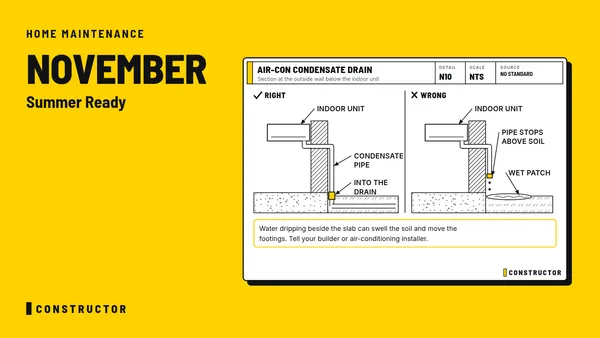
- Ask them to clean the coils and check the condensate tray and drain.
- Ask them to confirm the condensate goes to a drain, not the ground.
- Record the service in your log.
Weak airflow, ice on pipes, water dripping indoors, or strange noises.
The unit leaks, trips the power or won't cool. Call your licensed air-conditioning contractor.
Where you live changes the timing
Your October home maintenance depends on the season ahead:
- North (QLD, NT, northern WA, northern NSW). Storm and cyclone season is close. Finish the gutters, trees and tie-downs this month.
- South (temperate areas). Bushfire season is close. Clear the gutters, vegetation and anything that burns from near the house.
Every month, as well
Alongside your October home maintenance, do the five monthly checks:
- Test every smoke alarm with the test button.
- Clean the air-con filters while you're using it.
- Check wet areas for mould and run the exhaust fans.
- Walk around and note new cracks, leaks, stains or sticking doors.
- Record what you did in your maintenance log.
The short version
October home maintenance clears the path for storm water: gutters, box gutters, pits and the pump. Check the roof from the ground, secure loose items and book the air-con before summer. Our C18 6 Month Maintenance checklist covers each check, and our C8 metal roof guide shows what good box gutters and flashings look like.
Next month: November home maintenance.
FAQs
Why does October home maintenance focus on gutters?
Storm season in the north and bushfire season in the south both start soon. Clear gutters stop overflow into ceilings and remove dry leaves that can catch embers.
Can I clean box gutters myself?
No. Box gutters and roof valleys mean walking on the roof. Book a roofer or gutter cleaner.
How do I check the roof if I can't go up there?
Use binoculars from the ground and from upstairs windows. Look for lifted capping, cracked pointing, rust and gaps around flashings, then call a roofer for anything you find.
Do I need to service a new air-conditioner?
Yes. Service it as the maker's manual says, and keep the record, because some warranties need proof of servicing.