

The National Construction Code (NCC) and Australian Standards exist to make Australian homes safe, durable and consistent. In practice, too often they aren't followed or checked:
- Builders and tradespeople often don’t know or follow the standards. Many rely on what they were taught on the job rather than formal guidelines.
- Consumers pay for quality but often receive substandard work. When mistakes happen, rectifications are costly and time-consuming.
- If standards are only referenced after defects occur, are they truly serving their purpose?
The Case Study: Condensation Defects in New Homes
One of the clearest examples is condensation. Tighter, better-insulated homes are more energy efficient, but they also trap more moisture if the wall and roof build-up and the ventilation aren't designed and installed properly.
Builders and trades often overlook vapour permeability, ventilation and moisture control. The result is mould, damaged framing and linings, and health problems. The NCC has condensation management requirements (strengthened in NCC 2022), but they're not well understood or checked.
What Are the NCC and Australian Standards Supposed to Do?
The NCC and Australian Standards were established to create a uniform framework for construction across Australia. They aim to:
- Ensure buildings are structurally sound, safe, and durable.
- Improve livability, energy efficiency while preventing unintended defects (e.g., condensation issues).
- Protect consumers from poor workmanship and non-compliant builds.
- Standardise practices across trades and ensure accountability.
Despite these goals, compliance is inconsistent. Builders often prioritise cost-cutting over quality, and trades rarely have the time or resources to stay updated on evolving standards. As a result, construction defects persist despite regulations being in place.
See the further reading section for our posts on ventilation and air tightness/control layers.
The Disconnect: Why Trades and Builders Ignore Standards
If Australian Standards and the NCC set clear guidelines, why do so many builders and trades fail to follow them? The reality is that tradition, cost, and accessibility play a bigger role in daily construction work than formal regulations ever have.
Learning on the Job vs. Learning the Standards
For many tradespeople, their main education comes from working under more experienced builders, not from reading the NCC or Australian Standards. The problem? Bad habits and outdated practices get passed down just as often as good ones.
Ask a veteran builder or contractor about their methods, and they might say,
"I’ve been doing it this way for 30 years, never had a problem till you came along!"
But does that mean it complies with today’s standards? Not necessarily. Many rely on gut feel and experience rather than documented best practices—until something goes wrong.
“I Don’t Have Time to Read Standards”
Most tradespeople work long hours under tight deadlines, balancing multiple jobs at once. Sitting down to read hundreds of pages of regulatory text simply doesn’t fit into their schedule. It’s easier to stick with what they know than to research updated requirements.
The Cost of Access: When Standards Are Locked Behind a Paywall
Even if a builder wants to stay up to date, accessing Australian Standards is expensive. Unlike the NCC, which is free to access online, many Australian Standards documents come with a hefty price tag. Expecting individual trades to purchase multiple standards just to do their job properly is unrealistic.
Check out the further reading section for our post on the end of free access to Australian standards.
Regulations as a Footnote: The Missing Details in Plans
Even when a project references standards, it's usually a blanket clause, not specific instructions. A set of plans might say "Install in accordance with AS 4200.1", but unless the builder owns that standard, reads it and puts the details on the drawings, nobody on site knows exactly what it means in practice.
And let's be honest, most of them don't read it.
Builders may not ignore standards deliberately, but without training, access, or enforcement, they continue to build the way they always have, unaware of the risks.
The Consequences of Ignoring Standards
Most homeowners assume their builder follows the rules. When corners are cut, the damage often isn't immediate: cracking, waterproofing failures and structural problems can take months or years to show. By then repairs are expensive, and if the builder denies liability, the homeowner pays.
The Legal Minefield of Construction Defects
Most homeowners assume their builder will fix problems under warranty, but that’s rarely the case without a fight. The moment a defect is reported, the blame game begins.
"When did you first notice it? Why didn't you report it at your 6-month maintenance inspection?"
It's a common line builders use to push back on a defect.
Builders often rely on vague warranties, disclaimers, or contractual loopholes to avoid fixing defects. Some insist the problem is due to natural settlement, homeowner neglect, or even the weather. Meanwhile, homeowners are left navigating warranty claims, consumer tribunals, and legal disputes that can drag on for years.
Instead of preventing defects by following standards, the industry often treats them as a legal matter to resolve after the fact. And that’s the problem—homeowners shouldn’t have to become legal experts just to get what they paid for.
Regulatory Oversight: Who Actually Checks Compliance?
Who actually checks that the NCC and Australian Standards are followed? Less than most homeowners think. Oversight is fragmented, and a lot of construction quality simply goes unchecked.
Building Certifiers: Limited Scope, Limited Power
Building certifiers (I'm talking about Queensland here) don't check detailed workmanship. Their mandatory inspections happen at set stages, such as footings, slab, frame and final, and focus on the broad NCC requirements like bracing and tie-down. They're not checking every detail against every standard.
They don’t get into the finer details—like whether waterproofing is properly applied, insulation is installed correctly, or whether cheap, non-compliant materials are used instead of the specified products.
Certifiers also spend a lot of time, often unbilled, sending error-filled applications and plans back to builders to fix. That's time not spent on their core job of checking compliance.
Council Inspections
Local councils inspect plumbing and drainage work, but they don't verify general build quality. That stays with the builder.
A council plumbing inspector won't check whether the right fasteners were used, whether waterproofing membranes were applied correctly, or whether the walls were painted properly.
Self-Regulation: A System Built on Trust (That Doesn’t Work)
In many cases, the construction industry relies on self-regulation, meaning builders and contractors are expected to sign off on their own compliance. This is where things start to fall apart.
Some builders take compliance seriously. Others cut corners, knowing no one is checking their work in detail.
There’s no systematic auditing process, no independent verification, and no guarantee that what was approved on paper actually made it into the final build. By the time defects appear—sometimes years later—the damage is done, and homeowners are left scrambling for recourse.
No Mandatory Compliance Checks for General Building Work
Unlike electrical and plumbing work, which need compliance certificates, general building work has no mandatory final check that the details meet the standards.
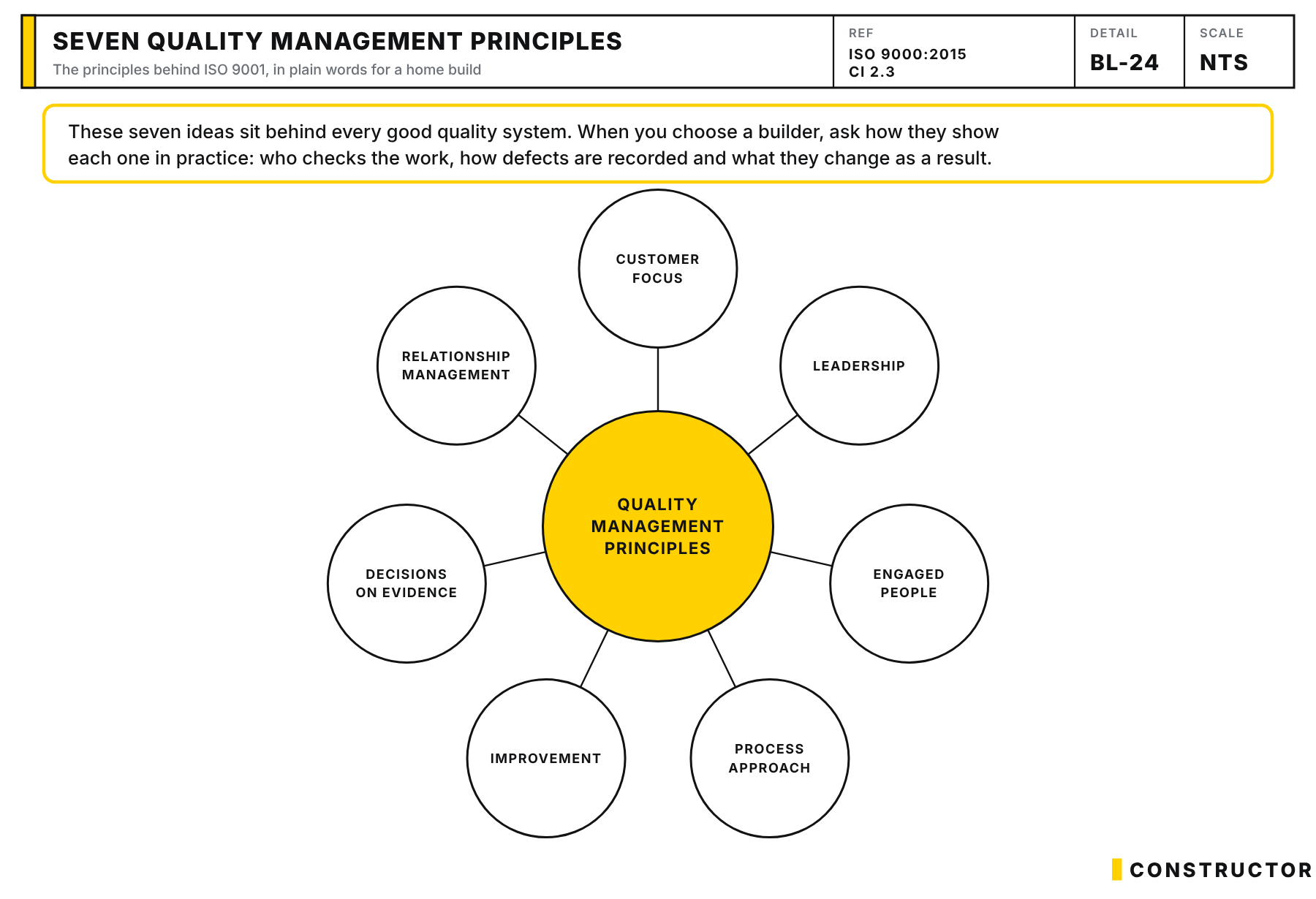
Once a home is built, there's no official quality control process to confirm every part of it meets the standards. The certifier issues a final inspection certificate (Form 21 in Queensland), but it relies heavily on certificates and sign-offs submitted by the builder and trades. In effect, contractors self-certify compliance without showing how they met the standards (in other words, without a quality management system).
From the outside, everything might look compliant—but dig deeper, and you’ll find that the scope of each certificate often may not align with the standards that actually apply. It’s a system that leaves a lot of room for oversight, a lot of trust and hope.
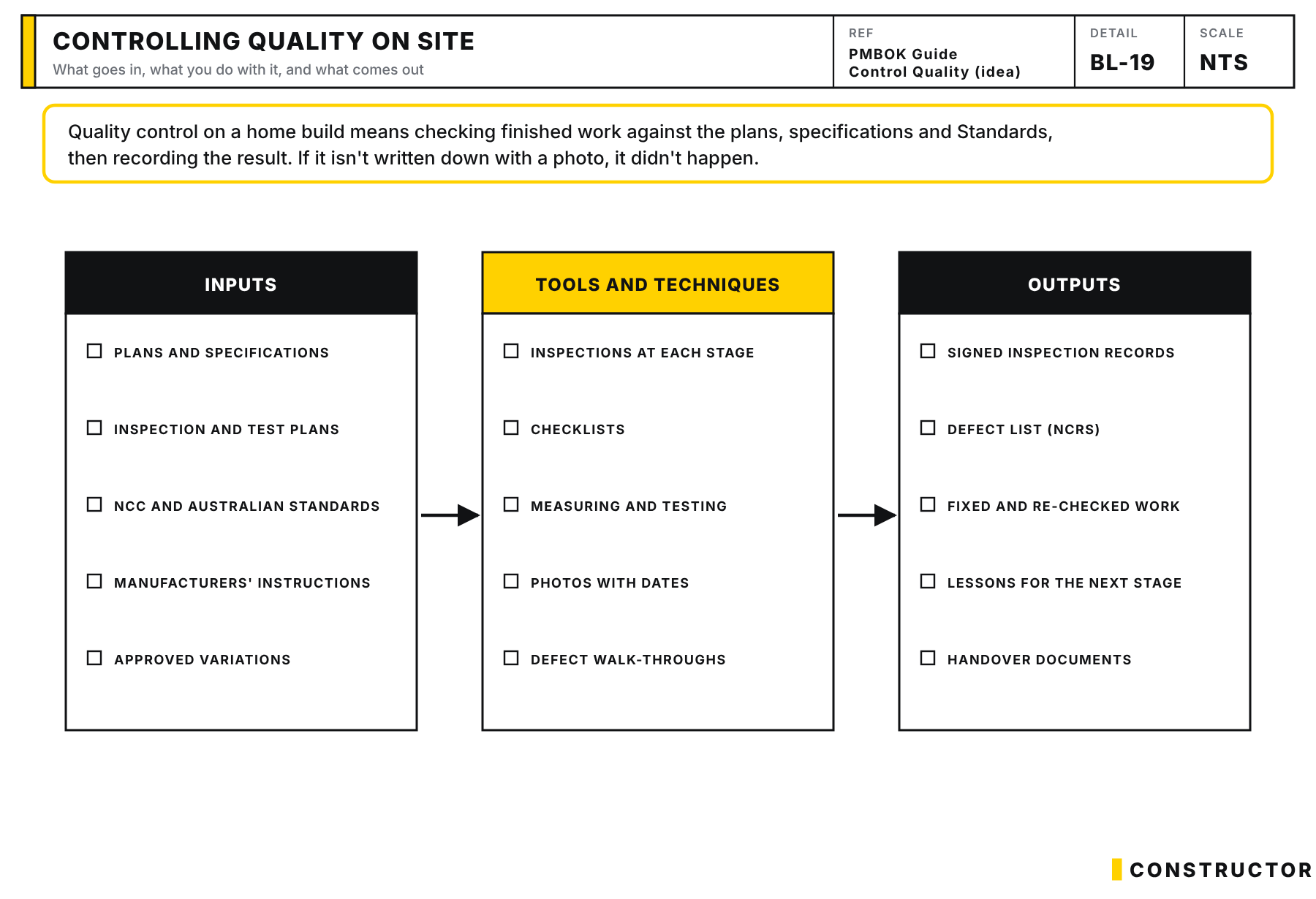
Unless a defect is obvious at handover, homeowners have no formal guarantee their house was built correctly. If builders and contractors used ITPs (inspection and test plans) with witness hold points, where work stops until it's checked, plus a basic quality management system, it would go a long way towards ensuring compliance.
I know the objection: the industry is already struggling to meet housing demand, and extra checks like a quality management system would slow builds down. They would. They would also prevent a lot of defects, and fixing defects after handover is slow and expensive too.
The Reality of Compliance: Homeowners Are Left to Find Problems Themselves
Most people assume that if a home has been approved and certified, it must have been thoroughly checked for compliance. But in reality, compliance systems are patchy at best, and outright flawed at worst.
The burden of finding problems falls on the homeowner. Unless you hire an independent building inspector or engineer, do your own research or spot defects early, you could be living in a non-compliant home without knowing it, despite contractors' forms "signing off" their work as compliant.
Builders do quality checks, but mostly to discharge liability and meet minimum compliance. I have yet to see an Australian builder with a quality management system focused on delivering the best product for the customer rather than turning houses over.
Does each contractor who signs off a work package have a quality management system? If their work is self-certified, how do we know it complies? Should we just trust them?
Why Marketing, Not Quality, Drives Australian Housing
Most homebuyers assume that regulations guarantee a high-quality build, but in reality, marketing does most of the heavy lifting in selling homes, not ensuring their quality. Builders don’t win contracts by showcasing their superior compliance with the NCC or Australian Standards.
Instead, they sell an image, a dream, and a lifestyle, often leaving homeowners with a product that doesn’t match their expectations.
The Illusion of Display Homes
Step into a display home, and you’ll be sold perfection—the finest materials, flawless finishes, and high-end appliances. But here’s the catch: most of what you see isn’t included in the standard build. Display homes are carefully curated marketing tools designed to close the sale, not to set realistic expectations of the final product.
The Power of Sales-Driven Messaging
Marketing in the residential construction industry isn’t about building the best possible home—it’s about maximising appeal and minimising objections. Builders invest heavily in branding, targeted advertising, PR messaging and customer persuasion, ensuring potential buyers focus on granite benchtops, open-plan living, and “Hampton-style facades” rather than the nuts and bolts of construction.
Have you ever seen a builder advertise their careful and diligent adherence to the NCC, their compliant waterproofing methods or their commitment to structural integrity? Probably not. Compliance is assumed, not discussed.
Builders are incentivised to complete projects quickly to move on to the next job. This often means quality control is secondary to meeting sales targets. Corners get cut. Compliance is ignored. And by the time defects emerge, it’s too late for the buyer to do much about it. See further reading below for our post on time/cost/quality - the "holy trinity" of construction.
The End Result: A Buyer Beware Market
Once construction begins, homeowners quickly realise they are navigating an industry that prioritises speed and efficiency over precision and durability. And by the time defects become apparent—whether it’s waterproofing failures, cracking slabs, or condensation issues—the builder may have already moved on to the next project.
But here’s the real kicker: builders are only held accountable for a fraction of the lifespan of the home.
- In Queensland, QBCC home warranty insurance covers structural defects for 6 years and 6 months. Non-structural defects must appear within 6 months, and your contract gives a 12-month defects period from practical completion (QBCC New Home Construction Contract GC 29.1).
- The expected lifespan of a house is a minimum of 30 years.
- The average home loan is between 25 and 30 years.
So while homeowners are financially tied to their purchase for up to three decades, builders are only liable for defects for less than a quarter of that time. The rest? That risk is passed onto the homeowner and their insurance premiums.
At the end of the day, the system doesn’t incentivise long-term quality—it incentivises builders to meet minimum compliance for as short a time as possible. And when homes start failing long before the mortgage is paid off, it’s the buyer—not the builder—who pays the price.
Fixing the System: How to Improve Compliance and Quality
"It costs nothing to do the job right the first time. It costs a fortune to fix it later."
If the standards exist, why aren’t they being followed? And more importantly, how do we fix the system so that compliance actually happens? The solution isn’t just about enforcement—it’s about accessibility, education, accountability, and real consequences for cutting corners.
Make Standards Freely Accessible
How can we expect builders and trades to follow standards when they don’t have easy access to them? Unlike the NCC, which is freely available online, Australian Standards are locked behind paywalls. Expecting every builder, contractor, and apprentice to purchase multiple expensive documents just to understand compliance is unrealistic.
Standards should be open to all professionals and consumers. If compliance is the goal, then knowledge should be accessible, not hidden behind a subscription fee (see further reading for our post on this). Making these resources free would be the simplest and most effective way to improve industry-wide understanding and adoption.
Increase Training and CPD Requirements
Most builders and tradespeople learn on the job, which means that new regulations and evolving best practices rarely make their way into real-world construction sites. Without ongoing education and structured training, compliance becomes an afterthought rather than a core part of the trade.
A strong Continuing Professional Development (CPD) program should be mandatory.
Training should include condensation risk assessments, moisture control techniques, building science, waterproofing and best practices in structural compliance—all areas where poor execution leads to costly defects. Learning from mistakes after the fact isn’t good enough; we need to build knowledge before problems occur.
Proactive Inspections: Catching Problems Before They Start
Currently, much of the construction industry operates on a “wait until something goes wrong” model. Defects are only addressed after homeowners complain, take legal action, or report issues. By then, the damage is done, the costs are high, and the builder may have already moved on to the next project.
Instead of relying on consumer complaints, regular, proactive inspections should be standard practice. Third-party auditors should conduct random site inspections during construction, rather than only verifying compliance after handover. If a mistake is caught early, it can be fixed before it turns into a major defect.
Require Compliance Documentation
Imagine buying a car without a logbook, service history, or any verification that it’s roadworthy.
Now consider that this is exactly what happens with newly built homes.
Builders should be required to provide documented proof that their work complies with relevant standards before final approvals are granted. Compliance shouldn’t be an assumption—it should be verifiable, transparent, and provided to homeowners before they take possession of the property.
Mandatory quality assurance documentation would make compliance a real accountability measure, not a tick-box exercise (see Further Reading for our post on stress-free home building with a quality management plan).
Strengthen Penalties for Non-Compliance
Currently, many builders operate under the assumption that cutting corners comes with little risk. If they get caught, the worst they face is having to fix the issue after a complaint is made. But what about the cases where homeowners don’t notice defects until years later?
Without financial and licensing consequences, builders have little incentive to prioritise compliance over profit. The solution? Real penalties for non-compliance. Builders who repeatedly fail to meet standards should face fines, mandatory rectification work, and even restrictions on their license.
If poor workmanship costs builders more than doing the job right the first time, compliance stops being an afterthought and becomes the only way to stay in business (see Further Reading: Demand Better: Accountability in Australian Home Building).
Fixing the System Requires Commitment
The path to better compliance isn’t a mystery—we already know what needs to be done. The real question is whether there is the political and industry will to enforce these changes.
The reality is this: homeowners deserve homes that meet the standards they were promised. Until compliance is made easier, mandatory, and enforceable, we will continue to see costly defects, frustrated homeowners, and a construction industry that fails to live up to its potential.
What Needs to Change?
- Make Australian Standards freely accessible, as the NCC already is. Builders and trades can't follow rules they can't afford to read.
- Increase mandatory training and continuing education—compliance should not be optional.
- Introduce proactive inspections and compliance documentation, so builders prove they followed the standards before completion. ITPs, ITRs and ITCs (inspection and test plans, reports and certificates) go a long way to demonstrating this.
- Strengthen enforcement with real penalties—builders and trades must be held accountable when they ignore compliance requirements.
- Ensure consumer awareness—home buyers should have access to compliance reports and quality assurance documentation before purchase.
FAQS
- Are Australian Standards legally enforceable in residential construction?
Some standards are referenced in legislation, making them mandatory, but many are only guidelines unless explicitly required by contract or local regulations. - Why don’t builders follow the standards if they exist?
Many claim they are too expensive, difficult to access, or time-consuming to apply in real-world building scenarios. - Who checks if my home is built to the right standard?
Building certifiers and council inspectors conduct basic compliance checks, but they do not inspect everything. There is no comprehensive oversight ensuring all standards are followed. - How can homeowners verify compliance before it’s too late?
Request documentation, engage an independent building inspector, and educate yourself on key compliance requirements.
Further Reading
 12 Key Benefits of Home Ventilation Systems ExplainedConsidering the air quality in your new home? Dive into the 12 compelling benefits of installing a ventilation system. From controlling impurities and reducing temperatures to alleviating asthma symptoms and mitigating VOC impacts, discover how ventilation can enhance your living environment.
 Ventilation and Airtightness: Improve Comfort and EfficiencyAchieving a comfortable, healthy home requires balancing ventilation and air tightness. In this article we explore practical methods to improve both. Learn how to prevent air leaks, reduce condensation, and improve your home’s efficiency.
 Optimizing the 4 Control Layers for High-Performance HomesBuilding an energy-efficient home requires a good understanding of the four control layers: water, air, vapour, and thermal. In this post we look into how project builders can optimise these layers, ensuring homes are comfortable, sustainable, and cost-effective.End of Free Australian Standards: Impact AnalysisThis article discusses the end of free access to Australian Standards in public libraries since 2018, its effects on small businesses, safety compliance, and the balance between public and corporate interests. Options for future access and public mobilization strategies are also explored.
 Why Australian Standards Are Mandatory for TradesmenIf you’re a tradesperson in Australia, the Australian Standards are essential—it’s the law. Ensure safety and quality in every project. Discover why these standards matter.
 Understanding Nominative and Informative Building StandardsDo you truly understand nominative and informative standards? Present in many sectors, these standards play a significant role in construction. Understanding these distinctions can affect numerous decisions, from choosing materials to planning methods.
 Project Builders: From Building Companies to MarketersExplore the evolution of project builders from traditional construction companies to marketing-focused entities, offering standardised building products.
 Quality Management: A Tale of Craftsmen and ProductionThis article looks into the debate between craftsmanship & production-oriented building in residential construction. It highlights how quality management systems (QMS) can harmonise these approaches, ensuring consistency in quality whether the focus is on rapid production or detailed craftsmanship.
 Building Your Dream Home: Balancing Time, Cost, and QualityBuilding a new home can be both exciting and challenging. To ensure success, it’s important to balance the “holy trinity” of project management: time, cost, and quality. In this article, we’ll explore how you can achieve this balance and create your dream home
 The Hidden Cost of Rushed Home ConstructionBonuses for early home completion can sacrifice quality for speed. Rushing vital construction phases may lead to future costly repairs. Quality, not quickness, should be the homebuilding priority.
 Navigating Residential Construction Quality in AustraliaThe article sheds light on the quality challenges in Australia’s residential construction sector. It points out key issues like skill gaps, rushed construction schedules, and insufficient training.
 Elevating Residential Construction with SWMS + ITPsThe article explores the transformative role of Safe Work Method Statements (SWMS) and Inspection Test Plans (ITPs) in residential construction. It highlights how these tools not only enhance safety but also significantly improve quality management, offering an integrated approach to both.
 Understanding ITPs, ITRs, ITCs in Construction InspectionsLearn the distinctions and roles of Inspection Test Plans (ITPs), Inspection Test Records (ITRs), and Inspection Test Checklists (ITCs) in construction. Read how ITPs provide a systematic plan for checks and tests, while ITRs and ITCs document the outcomes of these inspections.
 Demand Better: Accountability in Australian Home BuildingWe’ve grown accustomed to flashy kitchens and sleek “hamptons style” façades, but what about the hidden quality issues? In this article we discuss why Australian builders and their directors must be held accountable for delivering healthier, more durable homes beyond mere compliance.
 Stress-Free Home Building with a Quality Management PlanTired of horror stories about botched home builds? The secret to a stress-free home construction lies in a Quality Management Plan (QMP). This plan outlines how quality will be achieved, monitored, and improved in your project.


