I've worn a lot of watches on site. Most don't last. Here are four types that do, and the one I'd buy.
What a site watch needs
- Durability: survives knocks, scratches, dust and mud. Tough cases and hard crystals help.
- Battery life: you don't want to charge it every night. Solar is ideal.
- Water resistance: rain, hosing down and wet sites. Look for at least 100 metres.
- Readability: big, clear numbers and a good backlight for early starts.
- Repairability: parts and service you can actually get.
- Useful features: alarms, countdown timer and stopwatch cover most site needs.
- Comfort: light enough to forget it's there, with a synthetic strap rather than leather.
- Cost: it's easy to overspend on a watch you'll bang into a door frame, so I've noted price for each.
A safety note first. Some sites and tasks don't allow watches or jewellery at all: lathes, drills and other rotating machinery (entanglement), and live electrical work (conductivity). Check your site rules, and take it off when in doubt.

Garmin Fenix
The Fenix series is built for outdoor use, with a reinforced case, sapphire crystal on some models, excellent battery life and solar charging on some versions.
- Good: tough, long battery life, GPS and health tracking, works with Android and iPhone.
- Not so good: expensive, bulkier than a normal watch, and more features than most people use on site.
- Price: at the premium end, well over $1,000 for current models.
- Tip: keep your receipt. Thermal receipts fade, so photograph it. Ask me how I know.

Apple Watch Ultra
A titanium case, a big bright screen that's readable in sunlight, and useful safety features like fall detection and emergency calling.
- Good: tough for a smartwatch, excellent screen, calls and notifications on your wrist, safety features.
- Not so good: only works with an iPhone, needs charging every day or two, and repairs are expensive.
- Price: about $1,400 and up.
It's a capable watch, but that's a lot of money to wear while carrying steel.
Casio G-Shock
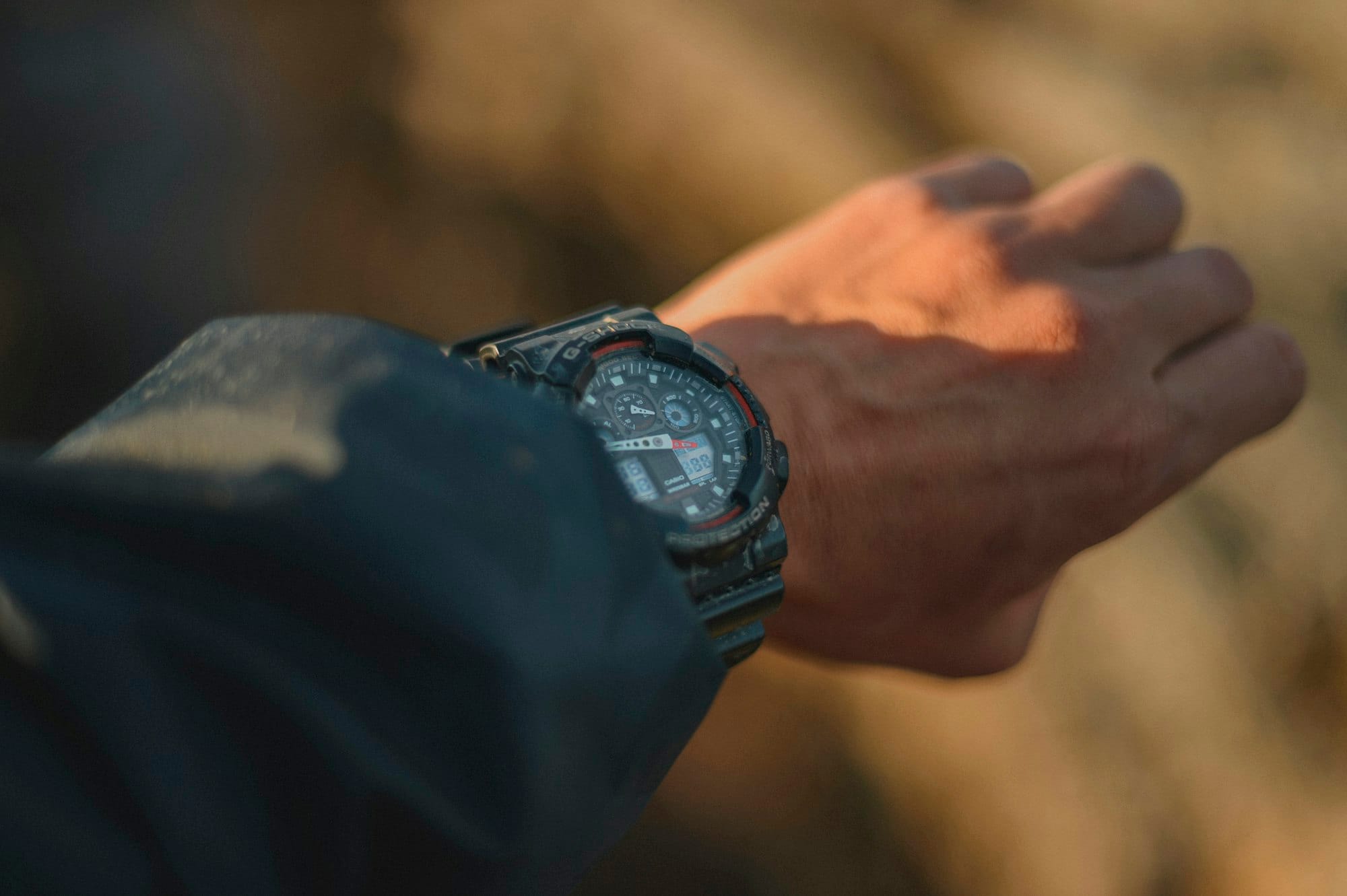
The G-Shock is close to the definition of a tough watch. The case and band are designed to absorb shocks, and most models are water resistant to 200 metres. Many have Tough Solar charging, so you rarely if ever need a new battery.
- Good: very tough, solar on many models, big backlit display, alarms, timers and stopwatch, cheap to buy and easy to service. Works without a phone.
- Not so good: no smartwatch features or health tracking.
- Price: a wide range, with plenty of good options under $300.
Swiss quartz watches
Swiss quartz watches use a battery-powered quartz movement, which handles knocks and vibration better than a mechanical watch. Look for stainless steel or titanium cases and luminous hands. The Luminox 3059 pictured is a typical example, with a 44 mm case and replaceable battery, priced at around $569.
- Good: accurate, durable, readable in low light, batteries typically last 2 to 5 years, and no phone required.
- Not so good: no smart features, battery changes needed, and servicing by an authorised repairer can be expensive.
- Price: moderate to high, depending on the brand.
My pick: Casio G-Shock GW-8900-1
The G-Shock GW-8900-1 is the one I'd buy. It's one of the toughest watches I own and it costs a fraction of a smartwatch. Expect to pay roughly $200 to $300 in Australia, depending on the retailer.
- 200 metre water resistance
- Tough Solar charging, so no battery anxiety
- Resin case and band with a metal bezel, tough but light
- 1/100 second stopwatch, countdown timer and 5 daily alarms
- Full auto LED backlight for dark mornings
Like a lot of people, a G-Shock was one of my first watches, and one still lives in my collection. You get a lot of wear without the worry of wrecking an expensive smartwatch.
Quick answers
How often will I need a new battery? A standard quartz watch, every 2 to 5 years. Solar watches rarely. Smartwatches need charging every day or few days.
Is a smartwatch worth it on site? If you want calls, notifications and health tracking, maybe. If you just want the time, an alarm and a stopwatch, a G-Shock does it for a fraction of the price.
Can I wear a leather strap on site? You can, but sweat and water will wreck it. Resin, rubber, nylon or metal straps last much longer.
What if my watch gets damaged on the job? If it's under warranty, contact the manufacturer, and use authorised service centres for repairs.
More gear for the site
 Top 5 Best Hard Hats for Construction in 2025Gear up smart, not just tough. We break down when you need a hard hat on a construction site, explain Type I/II - Class E/G/C and compare our top 5 best hard hats for 2025.
 Best Cold Weather Construction Gloves 2025Frozen fingers and dropped tools? Not on your site. Discover the best cold weather construction gloves of 2025—built to keep you warm, safe, and in control, no matter how low the temperature drops.