

If you're trying to build your first home, you already know the problem. Land, materials, labour and interest rates have all gone up faster than wages, and the deposit keeps moving away from you.
I've been building in Queensland for over 24 years, and I don't think there's one silver bullet. Affordability comes down to a handful of things working together: how many homes we build, how governments spend and tax, how we build, where people can live, and whether we're open to housing models other than a 30-year mortgage on a detached house.
Here's my take on each, and roughly how long each would take to make a difference.
1. Build more homes
When demand outstrips supply, prices rise. It really is that simple, and it's the part we've been worst at.
Under the National Housing Accord, federal, state and local governments have agreed to a target of 1.2 million new well-located homes over five years from 1 July 2024. That's about 240,000 a year, and so far completions have been running well below that pace.
What would help:
- Incentives for affordable housing. Tax breaks, grants or reduced fees for projects that include a share of affordable homes.
- Rezoning underused land. Old industrial sites and tired commercial strips can become mixed-use neighbourhoods with housing, shops and parks.
- Using government-owned land. State and local governments hold a lot of land that could be partnered with community housing providers or developers.
- Faster approvals. Every month a project waits on approvals adds holding costs that end up in the sale price. Fast-tracking projects that meet affordability criteria is an easy win.
- Building differently. More on this below, but factory-built housing could add capacity without needing an army of extra tradies we don't have.
Time frame: Rezoning and faster approvals can show results in 2 to 5 years. Large developments take 5 to 10. The key is to start and keep at it.
The real challenge is doing this inside the current system, with its bottlenecks in land release, approvals, trades and finance. In some cases we may need new systems altogether.
2. Government policy and subsidies
The housing market doesn't fix itself. Government support can help first home buyers and low-income households, but it has to be designed carefully.
The main levers:
- First home buyer grants and concessions. In Queensland, eligible first home buyers can get a $30,000 grant for a new home valued under $750,000, and from 1 May 2025 transfer duty was abolished for eligible first home buyers purchasing a new home or vacant land to build on. Check current rules with the Queensland Government before you rely on them.
- Shared equity. The federal Help to Buy scheme started on 5 December 2025. Housing Australia can contribute up to 40% of the price of a new home (30% for an established one), so eligible low and middle income buyers can get in with a 2% deposit.
- Social and affordable housing. Housing Australia (formerly the National Housing Finance and Investment Corporation, renamed in 2023) provides low-cost finance to community housing providers to build more homes.
- Rent assistance. It doesn't add a single home, but it gives renters immediate relief.
- Tax reform. Replacing stamp duty with an annual land tax, and reviewing negative gearing and capital gains tax concessions, have both been argued for by economists for years.
A word of caution on grants
Grants help the individual buyer, but if supply can't keep up, extra buying power tends to push prices up. The Reserve Bank has made this point in its commentary on housing, and the Grattan Institute's 2018 report Housing affordability: re-imagining the Australian dream argues that demand-side measures such as first home buyer grants mostly add to prices when supply is constrained.
We saw this during the Global Financial Crisis, when the boosted first home owner grant pulled a wave of first home buyers into the market and helped push prices up in some areas.
That doesn't mean grants are bad. It means they work best alongside more supply, not instead of it.
Time frame: Grants and rent assistance help within 1 to 3 years. Shared equity and social housing take 3 to 5. Tax reform is a 5-plus year job, and it only works if federal, state and local governments pull in the same direction.
3. Plan for population growth
Australia's population is projected to reach around 30 million in the early 2030s, mostly through migration. Migration fills skill shortages, including on building sites, but every new arrival needs somewhere to live.
Ways to balance it:
- Regional settlement. Visa incentives for migrants who settle in regional areas spread the demand.
- Long-term land planning. Enough land zoned for housing, with the infrastructure to support it, before the people arrive.
- Balancing temporary and permanent migration. Students and temporary workers mostly rent, so rental supply has to keep up.
- Using the data. Population and housing data can show where growth is coming, so supply goes there first.
Population growth isn't a bad thing. It's a sign people want to live here. It just has to be planned for.
4. Build smarter
Traditional building is slow and labour hungry, and we have a shortage of skilled trades. That's where new methods come in.
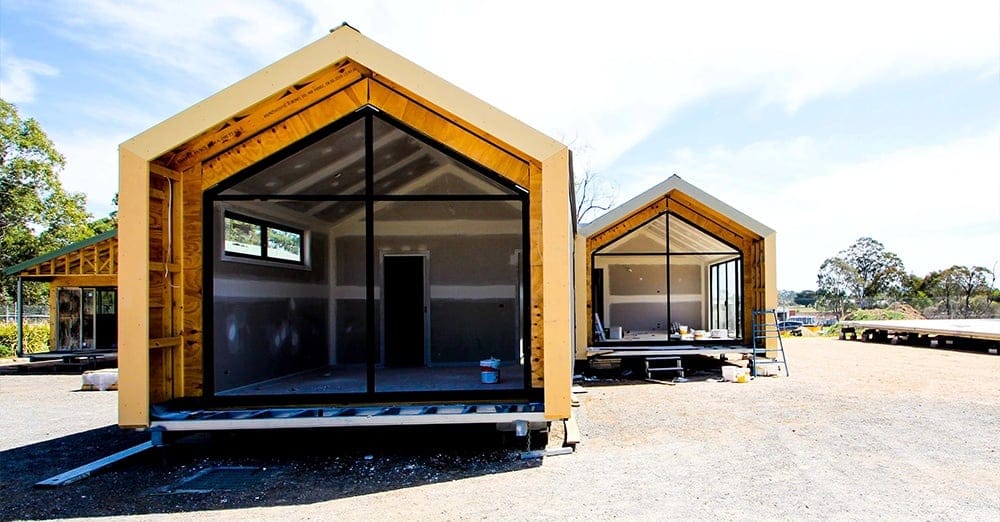
- Modular and prefabricated homes. Built in a factory, then trucked to site and assembled. Site works and factory work can run at the same time, which cuts build times. Australian firms such as Modscape and Archiblox are already doing this.
- 3D printing. Early days, but printed concrete walls have been trialled in Australia and could cut labour costs.
- Cross-laminated timber (CLT). Strong, lighter than concrete and quick to assemble. International House Sydney is a well-known example.
- Smaller homes. Compact designs, townhouses and tiny homes cost less to build and run.
- Energy-efficient design. Solar, rainwater tanks and good insulation cost more upfront but save money every quarter after.
My own view: factory-built social and affordable housing, run as a public-private partnership, could be a serious employer. It would combine manufacturing, logistics, building science and quality control, and offer young people a clear career path that looks a lot more appealing than a traditional apprenticeship does to many of them right now.
The hurdles are real: building rules written for site-built homes, industry habits, and buyers who still picture "prefab" as a site office. The ABCB has published a handbook on prefabricated, modular and offsite construction to help, and I expect the rules to keep catching up.
 Anthony Painter
 Anthony Painter

5. Improve transport and infrastructure
Demand piles into the cities because that's where the jobs, schools and hospitals are. If you can get to work easily from further out, cheaper land suddenly makes sense.
- Public transport. Projects like Sydney Metro West, Melbourne's Metro Tunnel and Brisbane's Cross River Rail make outer areas more reachable.
- Roads. Better roads cut commute times and support regional growth.
- Transit-oriented development. Housing, shops and offices built around transport hubs make better use of existing infrastructure.
- Regional services. Schools, hospitals and community facilities make regional towns a real option for families.
- Walking and cycling. Safe footpaths and bike lanes reduce the need for a second car, which is a real saving for a young family.
Time frame: New bus routes or bike paths help quickly. Train lines and major roads take 5 years or more, but they can change entire regions.
6. Regulate the market sensibly
Some of our price growth has come from speculation. Sensible rules can help keep homes as places to live, not just assets.
- Vacancy taxes encourage owners of empty homes to rent or sell. Victoria already has one.
- Foreign investment rules. Foreign buyers already need approval through the Foreign Investment Review Board.
- Negative gearing and capital gains tax. These encourage investment buying, and reform is regularly debated.
- Tenant protections. Longer leases and limits on rent increases give renters stability, though rent control is contentious.
- Transparency. Real-time sales reporting and anti-money laundering monitoring by AUSTRAC help keep the market honest.
- Short-term rental limits. Restrictions on whole-home short-stay letting keep more homes on the long-term rental market.
The balance matters. Over-regulate and you scare off investment in new housing. Under-regulate and prices run away.
7. Look beyond the standard mortgage
Owning a detached house outright isn't the only way to have secure housing.
- Community land trusts. A non-profit owns the land and leases it, so residents only buy the house. Resale prices are capped to keep homes affordable.
- Housing co-operatives. Residents own and run the property together. Common Equity Housing Limited in Victoria is one of the largest in Australia.
- Co-housing. Private homes with shared spaces such as kitchens, gardens and workshops.
- Build-to-rent. Large, professionally managed rental developments offering longer, more secure leases.
- Tiny home villages. Small, low-cost homes, often in regional areas.
The challenges are awareness, finance (banks don't always know what to do with these) and planning rules that weren't written with them in mind.
 Anthony Painter
The bottom line
None of this happens overnight, and no single measure fixes it. More supply, smarter policy, better building methods, decent infrastructure, fair rules and some fresh housing models all have to work together.
If you're building now, the practical takeaway is simple: know which grants and concessions apply to you, keep your design sensible in size, and get your contract and budget right from the start.
FAQs
Why is housing affordability such a big issue in Australia?
House prices have risen much faster than wages. Limited supply, population growth and high building costs all contribute.
How does more supply help?
More homes means less competition between buyers and renters, which slows price growth.
What are modular homes?
Homes built in sections in a factory and assembled on site. They can be quicker to build and help add supply without as many site trades.
Can rent control fix the problem?
It can give renters short-term relief, but it doesn't add homes. It has to be paired with more supply.
How long until things improve?
Rent assistance and grants help immediately. New housing and infrastructure take years.
Further reading
 Addressing Australia’s Housing Affordability CrisisThis article looks into the root causes of the housing affordability crisis in Australia, highlighting demographic changes, supply shortages, and potential policy solutions to make housing more accessible.
 Boomer Bonds: How To Create Affordable Housing in AustraliaAustralia’s housing market has reached a tipping point. Discover an innovative solution—Boomer Bonds—that leverages property equity to fund affordable, community-focused housing while offering a win-win for all generations.
 Build-to-Rent: Benefits of Renting Over Owning a HomeDiscover how the build-to-rent model provides a viable alternative to home ownership, benefiting renters and aiding government housing strategies.
 Shrinking Homes: A Crisis for Modern FamiliesDiscover how the dramatic reduction in house block sizes over the past 30 years is impacting modern families. With developers and councils prioritizing profits, families struggle to find space for basic needs. Learn about the consequences of this trend and the urgent call for change.


