
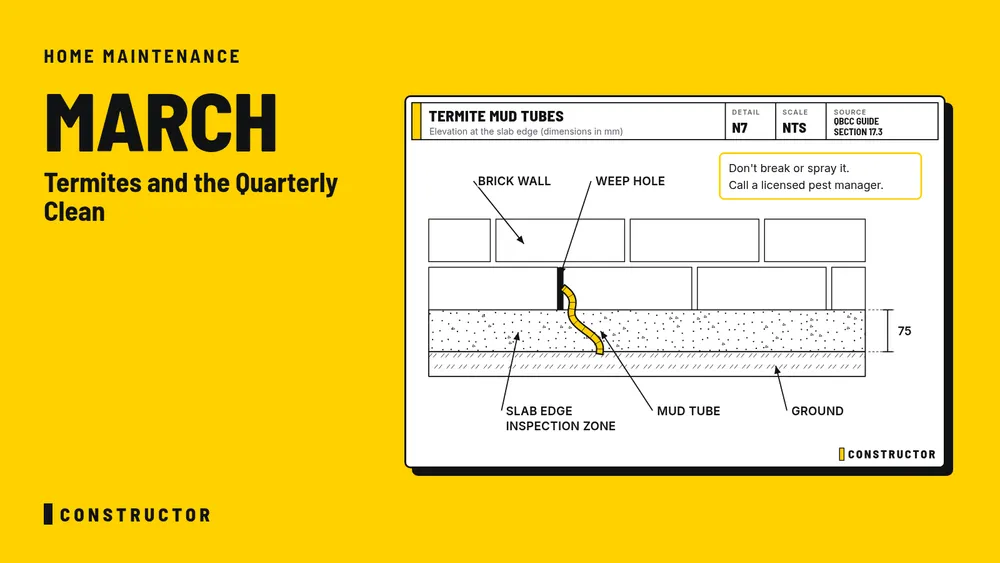
March home maintenance is about termites, which are still active in the warm months, plus the quarterly clean of filters, vents and the rainwater tank. These six checks follow the March page of your printed calendar and take about an hour.

C18 - 6 Month Maintenance Checklist
$59.00 AUD
Checklist Type: Minor
Form Factor: Fillable, print-ready PDF (A4, 19 pages) with a maintenance calendar and log
When to use: After handover: your first six months and ongoing home maintenance
A 110-point home maintenance checklist with a calendar and log. Plan preventative maintenance, find small problems early and keep your warranties in good order.
✓ Authorship verified on the blockchain · View certificate
This month's checks
These March home maintenance checks come from the termite, appliance and tank sections of our C18 6 Month Maintenance checklist.
1Check the slab edge is exposed

Many termite systems rely on you, and your pest manager, seeing termites come up the slab edge. A covered slab edge hides them, and it can void your termite warranty.
- Walk right around the house with a tape measure. At least 75 mm of slab edge should show above the garden, turf or paving all the way round.
- Look for anything covering it: soil, mulch, garden beds, turf, paving, steps, render, tiles, cladding, coatings, plastic sheeting or flashings.
- If your walls are rendered and the termite barrier includes a sheet under the brickwork, check its outer edge is still visible, not rendered, painted or patched over.
- Check nothing is stored against the walls, especially timber.
- Rake back mulch and soil that has crept up the edge.
A slab edge you can't see, garden beds built up against the wall, or new paving laid hard against the house.
If the slab edge or barrier has been covered or disturbed. Ask a licensed pest manager to check the termite system before you change anything else.
AS 3660.1 (clause 4.4) and the QBCC Standards and Tolerances Guide (section 17.3) rely on a 75 mm visual inspection zone around the perimeter, and the standard counts all of the coverings above as hiding it. Where the owner covers or blocks that zone, it isn't the builder's defect.
From the makers' guides.
- Keep the bottom of fibre-cement cladding at least 150 mm above soil and 50 mm above paths, decks, steps and driveways, with the ground falling away (typically 50 mm over the first metre). It must never sit in standing water.
- Synthetic turf near the house should slope slightly away from the walls and must not cover the slab edge. Keep the sand infill topped up, keep chlorine bleach and caustic cleaners off it, and send in the warranty form, because the maker says claims are void without it.
2Look for mud tubes and damaged timber

Termites can eat out framing, skirtings and door frames from the inside. By the time you see damage, they've often been there a while.
- Check the termite notice, usually in the meter box, for the system type and the last inspection date.
- With a torch, look along the slab edge, around pipes, and in the garage. Look closely at rough, honeycombed or rippled patches on the slab edge, and any plastic membrane folded over it: AS 3660.1 notes these can hide mud tubes.
- Look for thin mud tunnels running up walls or piers.
- Tap skirtings and door frames lightly with a screwdriver handle and listen.
- Check nearby trees, old stumps and timber sleeper retaining walls too. Make sure no timber steps, posts or decks sit in soil: keep soil, mulch and beds clear of deck posts and framing (the deck checklist uses a 75 mm gap, and says to have the termite system checked every 6 to 12 months).
- Homes on stumps or piers: keep at least 400 mm of clear space under the floor, with nothing stored there and no soil built up. Check the metal ant caps for mud tubes built around them. On a sloping site the clearance can drop to 150 mm, but only at the inside face of an external wall.
Mud tubes, hollow-sounding timber, blistered or bubbling paint on timber, or mud packed into joints.
If you see any of these. Call a licensed pest manager straight away. Don't break the tubes or spray them yourself. Book a professional termite inspection every 12 months anyway, or every 3 months in a high-risk area (QBCC).
Under the NCC Housing Provisions (clause 3.4.3), the termite notice must give the installer's or maker's recommended inspection frequency. The QBCC guide (section 17.1) makes regular inspection the owner's job.
3Clean the rangehood filters, dryer vent and dishwasher filter
Greasy rangehood filters stop extracting steam and smoke. A blocked dryer vent is a fire risk. A dirty dishwasher filter leaves food on the dishes and can cause smells.
- Rangehood: unclip the metal filters. Soak them in hot water and degreaser, or run them through the dishwasher, and dry them.
- Dryer: clean the lint filter, then check the vent or duct is free of lint.
- Dishwasher: twist out the filter, rinse it and refit it, as the maker says.
- Wipe down the oven, cooktop and rangehood. If you moved a freestanding gas cooker to clean, check its anti-tip bracket or chain is still in place.
- Exhaust fans: from the manhole, look only, and check the bathroom, kitchen and laundry fans duct to the outside, not into the roof space. Check the dryer vents outside too.
Grease dripping from the rangehood, the dryer running hot or taking much longer, or a dishwasher that won't drain.
If a motor, fan or element fails. Use an appliance service technician, and check the warranty first. A licensed gasfitter refits a cooker restraint, and a licensed electrician re-ducts or replaces an exhaust fan.
What the guides say. A hot shower releases about 10 litres of water vapour an hour and drying clothes about 5, and a house releases about 10 to 50 litres a day (ABCB condensation study). So run the exhaust fan through every hot shower and afterwards, and vent the dryer outside. At the next repaint, a glossier paint in wet rooms is easier to clean and resists mould better than flat paint (AS 2311).
4Clean the rainwater tank screens and first flush

Leaves and dirt wash into the tank and block the screens. The first flush device catches the dirtiest water off the roof. If it's full, that dirt goes into your tank.
- From the ground, or a properly set-up ladder, remove the leaf screen at the tank inlet and rinse it.
- Release the first flush device as the maker says, and let the dirty water drain.
- Check the pipework and fittings for leaks.
- Turn on a tap fed by the tank and check the pump runs and stops.
Overflowing screens, a first flush that won't drain, smelly or discoloured water, or a pump that cycles on and off.
If the pump fails or pipework leaks. Call a licensed plumber. A backflow prevention device must be tested by a licensed, accredited backflow tester.
5Check the garage door reverses

An automatic garage door that doesn't reverse can crush a child, a pet or a car.
- Read the safety section of the opener's manual first.
- Clear the doorway, and keep children and pets well away.
- Put a piece of timber or a box on the floor in the door's path.
- Close the door with the remote and watch.
- The door should stop and go back up when it touches the obstruction.
The door pushes down on the obstruction, stops but doesn't reverse, or runs roughly on its tracks.
If it fails the test. Don't use it until a garage door technician has fixed it. Have the rollers and chain serviced each year.
6Run water in unused taps and flush unused toilets

Water that sits in pipes goes stale, and dirt builds up. Traps in rarely used basins and floor wastes can dry out and let sewer smells in.
- List the taps, showers and toilets you rarely use: the guest room, the outdoor tap, the second laundry tub.
- Run each tap and shower until the water runs clear and fresh.
- Flush each unused toilet.
- Top up rarely used floor wastes with water each month. The water seal in the floor waste is what keeps sewer gas out of the room.
- While you're at each tap, clean it the makers' way: warm soapy water and a soft cloth. No abrasives, cream cleansers, scourers, bleach or hydrochloric acid, which pits stainless steel. Rub stainless sinks along the grain, and never use ordinary steel wool.
Discoloured or smelly water, a gurgle, or a smell that comes back.
If the water stays discoloured or the smell keeps returning. Call a licensed plumber.
Where you live changes the timing
Plan your march home maintenance around your climate.
- North (QLD, NT, northern WA, northern NSW). It's warm and humid: peak termite activity. Look closely around the slab edge, the garage and anywhere damp.
- South (temperate). Autumn is starting, but termites are still active. Do the termite checks before the weather cools.
Every month, as well
Add these to your march home maintenance, as every month:
- Test every smoke alarm with the test button.
- Clean the air-con filters while you're using it.
- Check wet areas for mould and run the exhaust fans.
- Walk around: note new cracks, leaks, stains or sticking doors.
- Record what you did in your maintenance log.
The short version
March home maintenance is termite season work: keep the slab edge visible, look for mud tubes, and call a pest manager at the first sign. Then do the quarterly clean and test the garage door. More detail in our Ultimate Guide to Termite Barriers.
Next month: April home maintenance.
FAQs
How often should a pest manager inspect for termites?
Every 12 months, or every 3 months in a high-risk area (QBCC), and more often where your termite notice or pest manager recommends it. Check the notice in the meter box for the last date.
I found a mud tube. Should I knock it off?
No. Leave it alone and call a licensed pest manager straight away, so they can see the activity and find the source.
Can I put a garden bed against the house?
Not over the slab edge or termite barrier. Keep beds, mulch, sprinklers and paving clear so the edge stays visible. It matters for brickwork too: AS 4773.2 treats walls in regular wet-dry contact, such as a garden bed against the house, like a marine site.
How long does March home maintenance take?
About an hour. The termite checks take the longest, so do them first while the light is good.