July home maintenance is mostly outside: paint, timber, paths, fences and solar panels, plus a second test of your safety switches. It takes about an hour, not counting any painting or oiling, and follows the July page of your printed calendar.

C18 - 6 Month Maintenance Checklist
$59.00 AUD
Checklist Type: Minor
Form Factor: Fillable, print-ready PDF (A4, 19 pages) with a maintenance calendar and log
When to use: After handover: your first six months and ongoing home maintenance
A 110-point home maintenance checklist with a calendar and log. Plan preventative maintenance, find small problems early and keep your warranties in good order.
✓ Authorship verified on the blockchain · View certificate
This month's checks
1Test the safety switches (RCDs) again

A safety switch cuts the power if current leaks to earth, for example through a person. If it's stuck, it won't protect anyone.
- Tell the household the power will go off on some circuits.
- Open the outer door of the switchboard and press the button marked "T" or "Test" on each safety switch.
- Each one should trip straight away. Note which lights and appliances go off.
- Switch it back on.
A switch that doesn't trip, won't reset, or trips again and again on its own.
If any of these happen. A licensed electrician needs to check or replace it. Never remove the switchboard cover.
Queensland's Electrical Safety Office recommends a push-button test every three months. That's more often than this calendar's twice a year, so test more often if you can.
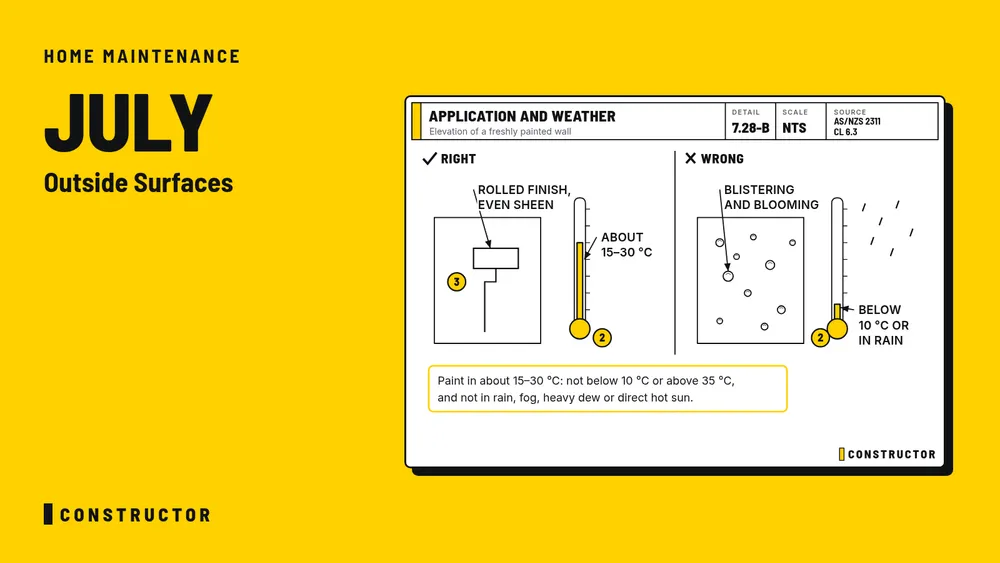
2Check the external paint and touch up

Paint is what keeps water out of render, fibre cement and timber. Once it cracks or peels, the material behind it starts to break down.
- Walk around the house on a dry, overcast day.
- Look at the walls, eaves, fascias, window sills and door frames, starting with the sides that get the most sun and rain.
- Rub a finger across the paint. A chalky residue means it's wearing.
- Touch up small areas with the paint from your handover colour schedule, as the maker says.
Peeling, blistering, flaking, cracking, heavy chalking or bare timber.
If large areas are failing, or the paint is high up. A painter can do it safely. In the first 12 months, tell your builder.
The QBCC Guide (13.5) treats paint as defective if more than 10% of the painted area fails by lifting, blistering or flaking. Clear and semi-transparent exterior finishes are excluded. Paint is judged from a normal viewing position of 1.5 m (1.4).
3Check external timber, decks and fences, and seal or oil
Sun and rain dry out timber, and it greys, splits and cups. A coat of oil or sealer in your driest month lets the finish cure well.
- Sprinkle a little water on the deck. If it soaks in instead of beading, it needs a coat.
- Look for loose or raised nails and screws, splits and soft spots.
- Push a screwdriver tip gently into any dark or soft timber. It shouldn't sink in.
- Clean, then oil or seal as the product maker says.
Soft or spongy boards, rot near the ground, wobbly balustrades, or rusting fixings.
If a balustrade moves, a board is soft, or a post is rotten. A licensed carpenter or builder should repair it. My guide to timber decks in tough climates covers finishes in detail.
The QBCC Guide (15.9) treats splits in decking that run to the end or edge of a board as defects in the first 12 months, if they're caused by the fixing method or workmanship.
4Pressure clean the paths, driveway and external walls
Dirt, mould and moss make paths slippery and hold moisture against walls.
- Read the pressure cleaner's instructions and test a hidden spot first.
- Use the gentlest setting that works on walls, render and painted surfaces.
- Keep the spray away from weep holes, window seals, vents, light fittings, power points and the meter box.
- Work from the ground. Don't use a pressure cleaner on a ladder.
Slippery paths, green or black growth, or dark staining that keeps coming back near the same spot. That can mean a leak or constant water.
If the mould keeps returning (find the water source first) or the walls are above single storey. A professional cleaner has the right gear.
5Clean the solar panels and check the inverter light
Dirt and bird droppings reduce how much power the panels make, and an inverter fault can stop the system without you noticing.
- Look at the panels from the ground. Never climb onto the roof.
- If they're dirty, follow your installer's cleaning advice. Often that means a hose from the ground, or a professional clean.
- Check the inverter display or light against the manual.
- Compare this month's generation with last year's, if your app shows it.
A red or flashing fault light, an error code, or generation that's suddenly dropped.
If there's a fault light or damage. Call your solar installer or a licensed electrician. Don't open the inverter or isolators.
6Check fences and retaining walls for leaning or cracks

A leaning fence or retaining wall can fall. Retaining walls often fail from water building up behind them.
- Sight along each fence and wall. It should look straight and upright.
- Look for cracks, bulges, leaning posts and gaps opening at joints.
- Check the weep holes or drainage outlets in the retaining walls are clear and draining.
- Photograph anything you're unsure of, with a tape for scale, and compare next year.
Leaning, bulging, new or widening cracks, soil washing through joints, or water ponding behind the wall.
If a retaining wall is leaning or bulging. Get a structural engineer or your builder to look at it. For boundary fences, my guide to dividing fences in Queensland explains who pays.
Where you live changes the timing
- North (QLD, NT, northern WA and northern NSW). The dry season is the best time for paint, deck oil and sealant work. Do your July home maintenance outside jobs now.
- South (temperate Australia). Winter rain. Check for leaks and damp now, and save the painting and oiling from your July home maintenance list for spring.
Every month, as well
- Test every smoke alarm with the test button.
- Clean the air-con filters while you're using it.
- Check wet areas for mould and run the exhaust fans.
- Walk around: note new cracks, leaks, stains or sticking doors.
- Record what you did in your maintenance log.
The short version
July home maintenance protects the outside of your house: paint, timber, paths and walls, plus your solar system and safety switches. Do the paint and timber in your driest month so the finishes cure well. The C18 6 Month Maintenance checklist lists every item.
Next month: August home maintenance.
FAQs
How often should I test my safety switches?
The calendar has you test them in January and July. Queensland's Electrical Safety Office recommends every three months.
Can I do July home maintenance in the rain?
The safety switch and solar checks, yes. Leave pressure cleaning, paint and oil for a dry spell.
When should I oil my deck?
In your driest months, when the timber stops beading water, and as the product maker says. In the south, that's usually spring rather than July.
What's the most important July home maintenance check?
The safety switch test. It takes minutes and it's the one that protects people.