You've come to the right place to learn all about residential construction and quality management. Before we forget, if someone forward you this newsletter, don't forget to subscribe to our newsletter so you never miss out!
🤗 Howdy Readers
In this newsletter, you'll find:
Post 1
Our Checklists are chonky, and we know it. Here's Why
and
Post 2
Why Your New Home Might Not Be as Energy Efficient as Promised
What We’re Working On:
Our Fixing Stage Checklist is now out. It covers key inspection areas like gyprock installation, eaves, internal fixout, floor prep, ceramic tiling, joinery, and downpipe installation.
Get the C12 Fixing Stage Checklist.
📬️ Post 1: Our Checklists are Chonky, and we know it. Here's Why
Ever wondered why our checklists are so detailed? It's not to overwhelm you. It's to give you enough knowledge to make informed decisions and hold your builder accountable.
In this post we explain the reasons behind our checklist chonkification (it's a word, trust me, I'm a builder!).
Curious to learn more? Check out the full article here: Our Checklists are chonky, and we know it. Here's Why or click the link below.
 Anthony Painter
📬️ Post 2: Why Your New Home Might Not Be as Energy Efficient as Promised
You’ve just moved into your brand-new home, excited about the advertised 7-star energy rating and the promise of lower power bills. But after a few months, you notice your energy bills are higher than expected. What happened?
In this post we look at the "energy performance gap": the difference between how energy efficient your home was designed to be and how it actually performs once built. It usually comes down to material substitutions, rushed installation and miscommunication on site.
If you're building for the first time, knowing about the gap helps you make sure your home lives up to its rating, saving you money and keeping you comfortable.
Curious to learn more? Check out the full article here: Why Your New Home Might Not Be as Energy Efficient as Promised or click the link below.
 Anthony Painter
💾 Software of the Week: FillOut Forms
Better than Surveymonkey, Wufoo, Google Forms and integrates with databasing solutions like Airtable/SmartSuite
This is not a sponsored post - just software we're currently using and are sharing it with you
Looking for an easy way to build online forms, surveys or quizzes? Fillout Forms is a drag-and-drop form builder that needs no coding.
What is Fillout Forms?
You can build customised forms quickly for customer feedback, job applications, event registrations and more.
Key Features and Benefits
- User-Friendly Design: No coding required. Simply drag and drop to create forms that suit your needs. Conditional logic is available on all plans, often hidden in premium plans with other form software.
- AI Assistance: Leverages artificial intelligence to recommend form structures, making the creation process smarter and faster.
- Seamless Integrations: Connects with popular tools like Google Sheets, Airtable, Notion, Smartsuite and Mailchimp, ensuring your data flows smoothly across platforms (No data silos).
- Customisation Options: Tailor your forms with themes, logos, and custom domains to maintain brand consistency.
- Secure Data Handling: Offers enterprise-grade security with SOC 2 Type II compliance and 256-bit encryption, ensuring your data is protected.
- Form Signature Capture: this small feature is reason in itself to use fillout. Normally signature fields are hidden in expensive PDF signing solutions. While not accessible on the free plan, the starter paid plan gives you access to collect form signatures. Super handy stuff.
Who Should Consider Fillout?
Fillout is ideal for small to medium-sized businesses, educators, HR professionals, and non-profits seeking an efficient way to collect and manage data. Its versatility makes it suitable for various applications, from internal surveys to customer feedback forms.
Platform and Pricing
As a web-based application, Fillout works across all major browsers—no downloads necessary. It offers a generous free plan that includes unlimited forms and up to 1,000 responses per month. For those needing more advanced features, paid plans start at $15/month.
👉 Explore Fillout Forms


We use Fillout Forms daily and highly recommend it.
ICYMI - the most important construction news from this week
🚀 The latest residential construction news from new sources around Australia for the news week ending 15-05-2025 🔥
This Week’s Theme: "Where do we start? I know, pack them in tighter!"
Most articles just rehash the same message—“prices are going up”—which everyone already knows. When I go through the news each day, I try to find positive, constructive pieces that seem to be moving the needle in a better direction.
This week’s main focus was on “multi-generational housing” and “dwellings within dwellings.” It’s an infill strategy—nothing more. It’s not a real supply strategy. It’s lazy: carve up what already exists into higher density to increase housing supply.
Two points on this:
- Infrastructure will need an upgrade. Most of it is ageing, and higher density means more demand, which means more maintenance.
- Car parking is already a problem. I just read that car spaces in Brisbane’s inner city are now reaching Sydney and Melbourne prices—$100,000 per park. There’s a finite number of car parks, regardless of how dense the housing becomes.
Yes, there are some clever stackable car parking solutions, but they still need space to install.
I’m not saying this approach isn’t worth considering—I’m just saying there are consequences. The overall effect of infill strategies is increased rates and costs. So yes, it might help the housing supply, but it also creates other problems.
Here’s the thought I can’t shake: we see genuine reform only when society suffers enough. Think “Port Arthur/gun laws.” Yet society is clearly suffering, and will continue to suffer, from a lack of affordable housing—and all we seem to do is shrink what already exists, rather than implement meaningful supply-side reform.
Big problems take time to solve, but that doesn’t mean you do nothing. A panacea might treat the symptoms, but the underlying issue remains. Real problems need real solutions, not band-aids.
And in an effort to help out our politicians, who seem stuck on how to fix things, we humbly submit this song for your consideration.
Can't see the video below? Click here to watch on YouTube.
We've highlighted our favourite news articles for the week by marking with a 🌯 or five
10-05-2025
2025 Houses Awards shortlist: New House over 200m² — [LINK]
🌯🌯🌯 NSW Building Commissioner to oversee repair of hundreds of defective homes in Shell Cove — [LINK]
Our comment: This is exactly why we published checklists C13A and C13B—both focused on waterproofing. The more you understand what waterproofing is, what to look for, and how to ask better questions on site during construction, the less likely you'll end up in the same situation as the homeowners mentioned in this article.
New rules for foreign investors clear a path for build-to-rent projects — [LINK]
Queensland’s rental market: A New Year, even fewer options — [LINK]
Delivering more social housing for New South Wales — [LINK]
Housing sentiment surges as rates fall and prices rise – NAB — [LINK]
🌯🌯 Innovative planning laws passed to fix Australia's housing crisis — [LINK]
Big bank’s huge rates call amid property confidence spike — [LINK]
Why the Australian housing crisis is forcing young Aussies to give up on homeownership — [LINK]
11-05-2025
No news of interest today. (Mostly editorials and paid placements by advertisers.)
12-05-2025
🌯 Government to expand prefab and modular construction to fast-track public housing build — [LINK]
Our comment: This is a good start, but precast concrete is not the right solution for modular housing. While concrete works well in commercial and industrial builds, residential projects often lack the space for cranes or back-propping heavy panels. There are many better options—timber, for one, is far more sustainable. This feels more like a knee-jerk reaction or lobbying win than a considered, long-term solution.
Report finds Victoria needs 80,000 new homes in next decade to begin addressing social housing crisis — [LINK]
🌯 Vested interests and weak incentives mire Australia’s housing in politics, red tape, and delays — [LINK]
Unsold apartments bog housing supply — [LINK]
13-05-2025
🌯🌯 A rich country in a housing crisis? (Audio) — [LINK]
Housing market sentiment rebounds across most of Australia — [LINK]
Episode 249: Llewellyn Regler & Mario Mey on cladding, the NCC, the façade market, Project Remediate, and why waterproofing matters (Audio) — [LINK]
DevCore secures approvals for over 3,500 homes — [LINK]
14-05-2025
🌯🌯🌯 Article from 2015 – still relevant: Explosive report lifts the lid on Australia’s building energy performance sham — [LINK]
Our comment: Yes, I know I harp on about building better quality and improving quality management, but there’s a reason for it. One, why not always try to do better? It’s more interesting than standing still. And two, it’s often much easier to improve the process than people think—and the results can be huge. Big changes are hard to swallow, but small, steady changes add up.
Better buildings: Designing solutions for sustainable architecture — [LINK]
Our comment: This article from UQ explains clearly how energy and water use in construction impacts sustainability. Most builders still aren’t making meaningful changes. Instead, we hear the same tired excuses: “It’ll slow us down,” “too hard,” “consumers won’t pay,” etc. It all adds up to “leave us alone.” It’s disappointing, but not surprising.
🌯🌯 A HAFF is not a home — [LINK]
This is the year you will be able to afford a home — [LINK]
Our comment: The comments section is actually worth a read on this one. Some thoughtful contributions.
🌯🌯 Housing market surge following Labor election victory — [LINK]
Our comment: Sharing this mostly because I recognised Chris Kohler from his YouTube channel. I don’t watch national TV, but I like his simple breakdowns on YouTube.
Can't see the video below? Click here to watch on YouTube.
‘Co-located housing’: A new housing model that has the potential to take off — [LINK]
🌯🌯 Builder failures collapse on housing supply targets — [LINK]
Our comment: Check out our C4 “Asking the Right Questions” checklist to help you do proper due diligence before signing a contract — [[LINK]](https://buy.polar.sh/polar_cl_SWMAVPXJgzAkcWGNYLWtXLPDgpblsnDnjGQjd38f6Ac)
🌯🌯 Could Japan’s 2×4 housing fix solve Australia’s housing crisis? — [LINK]
15-05-2025
How the cost of building a new house just hit a record high — [LINK]
Allens advises Stockland consortium on Australia's largest social housing project — [LINK]
🌯🌯🌯 Titled versus untitled land: What every first-home buyer needs to know in 2025 — [LINK]
16-05-2025
NT extends $50K grants for building or buying new homes — [LINK]
Busy Building Tassie Homes — [LINK] (updated 17-5-25 missed the link)
Our comment: This article isn’t exactly readable, but what stood out was the photo—specifically the house at frame stage. Take a look at the external wall frame in the background, furthest from the two people.
See the bottom plate with the opening (a window or door). It’s overhanging the slab by more than 15mm in places. That overhang will need engineering detail to make it compliant—typically a galvanised steel angle (see below) with masonry anchor bolts (AnkaScrews or screw bolts) at 150mm centres, depending on the roof and wall loads.
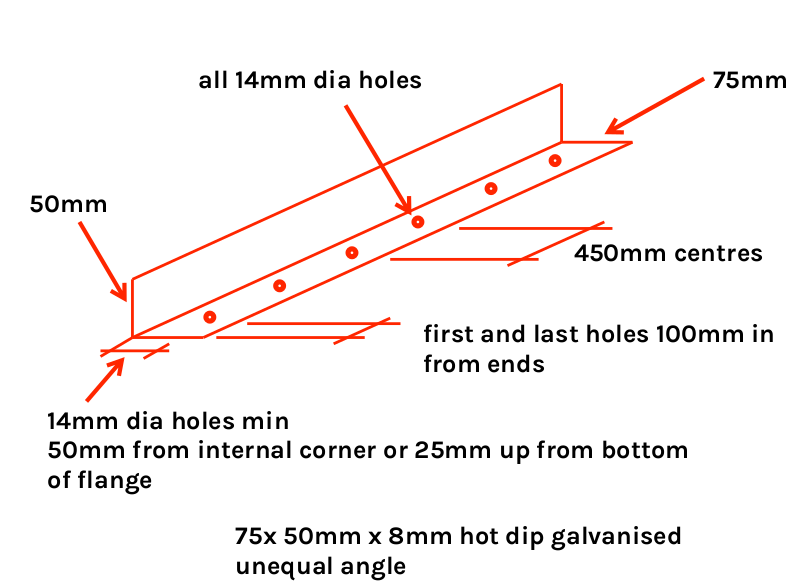
How does this even happen? Great question.
It usually starts with slab formwork not being measured properly. Maybe the formwork wasn’t the right length, wasn’t square, or wasn’t adequately supported (back propped/braced at sufficient centres)—leading to it shifting during the pour. The second major cause? Framing carpenters start the frame setout on the longest side of the house, flick a set-out line, square from this, and keep going without checking or adjusting as they setout at least the first few adjacent dimensions from the main "long side" of the house.
To be clear, this isn't a dig at the framers. Redoing a set-out is painful. Rubbing out chalk lines isn't fun, and neither is going over them in permanent marker after the first flick.
Overall, frame overhangs come from a combination of the slab being slightly the wrong size and the frame set-out not being adjusted to suit. And adjusting room sizes to suit the slab creates its own issues. The rooms may no longer match the plan dimensions. You can't run a wall out of plumb to hit the pitch point (that creates huge problems). And prefabricated trusses are made to plan dimensions, so moving walls changes the truss pitch points, which compounds the problem. The issue that keeps on giving 😄
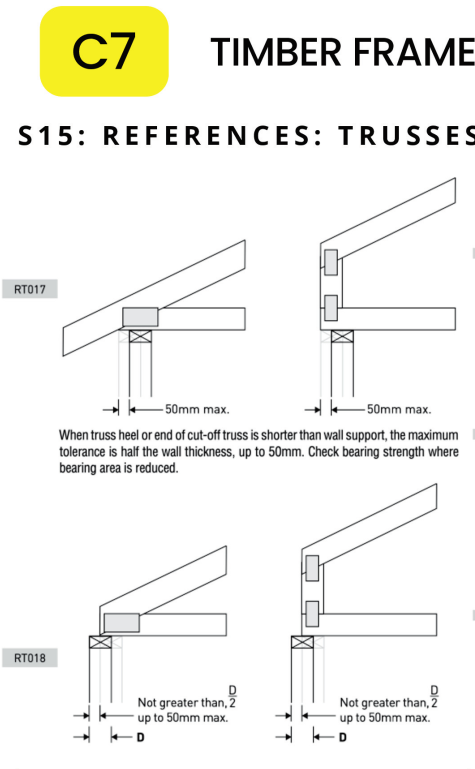
Pitch points must be no more than 50mm out, or half the wall thickness (70x35mm timber is common, so 70/2 = 35mm, and for 90mm it's 45mm; we builders do simple maths). See page 42 (of 44) of our C7 timber frame inspection checklist (and below). Either way, if the pitch point had to change to suit the slab, I'd be talking to the truss company and getting their sign-off or detailing to strengthen the affected trusses.
The prevailing attitude among some tradies—at least back when I was building these homes—was: “I’m not paid to fix that. Not my problem. The concreter should’ve done a better job. The supervisor should’ve caught it.”
So in the end, it’s no one’s fault, yet the problem exists. Like immaculate conception—a wondrous mystery!
🌯🌯 Australia’s housing upturn “loses momentum” — [LINK]
Housing finance softens in Q1 despite rate cut boost — [LINK]
Could Victoria’s planning reforms help solve the housing crisis? — [LINK]
NSW’s first ever 3D-printed social homes now complete — [LINK]
The Last Word
There are solutions to housing affordability. Modular construction is the fastest way to increase supply. Yes, it requires land development—but every state government, and the federal government, already has land. We don’t have to rely on private developers to foot the bill and squeeze livability into a shoe box to make the numbers work.
As for 3D printing—I don’t think it’s the answer either. For one, it’s cement-based, which isn’t great for sustainable construction (even if it performs well on energy efficiency). And practically speaking, you need a lot of space and favourable conditions/working environment to run these machines—yes, even the robotic versions. I’d love to be proven wrong, but I don’t see 3D printing becoming viable at scale for at least another 15+ years.
What we need is systematic change and fresh thinking. This is an opportunity to rebuild an industry that’s clearly in trouble. Covid didn’t just disrupt construction—it exposed its weaknesses. The sector has become bloated, defensive, and out of touch. Everyone’s complaining: quality is too hard, regulation is too hard, consumers are too demanding, and there are no tradespeople left. Instead of adapting, the industry is asking for the bar to be lowered.
At the same time, marketers have taken over residential construction. The focus has shifted from building quality homes to selling glossy, surface-level dreams. It’s completely backwards. While we’re trying to reduce energy use and improve livability, most building companies are doing the least they can to boost margins. There’s no alignment with what society actually needs.
We’re at a generational turning point in the industry. The guard is changing—but the problem is, the new “leaders” aren’t builders. They’re promoters and yield optimisers, not builders.
If the government wants real change, it needs to change the rules of the game—rather than let archaic thinking run the industry into the ground. We're nearly there already: builders are going broke while industry associations cry out, “Make it easier for us to keep doing what we've always done."
There’s plenty of market space for volume builders to keep doing what they do. But why let them dictate the terms of the entire industry?
Add competition. Challenge the status quo. Stop protecting outdated business models. Let’s actually build something better.
Can't see the video below? Click here to watch it on YouTube.
Can't see the video above? Click here to watch it on YouTube.
The Final, Last Word 😄
Have you noticed more international investors are buying or taking majority ownership of Australian construction companies?
If you think housing prices are high now, just wait until these players really start turning the screws. The reason they’re investing is simple: returns. They see Australia as a high-yield, long-term opportunity—a buoyant, profitable market.
And like any investor, once they’ve bought in, they look to maximise yield. How do you increase yield in construction? By raising prices.
So be prepared for what I’ll call the Big Squeeze of residential construction. Want a glimpse of what that might look like? Look no further than D.R. Horton—a housing juggernaut in the U.S. Now go search out consumer reviews.
Consolidating the market into just a handful of large players is rarely good for the consumer. It reduces competition, limits choice, and shifts the focus from quality to volume and margin. Governments don’t want big builders to fail—so when they start to wobble, they prop them up. But this kind of artificial support doesn’t address the underlying problems. It doesn’t fix poor quality control, weak governance, or the lack of real innovation in how homes are built.
Instead, it rewards scale over substance—and leaves homeowners paying the price.
Once the market consolidates and the big players dominate, you get less choice, higher prices, and—frankly—a bigger squeeze.
The Constructor Forum
Got a question, or want to share some quality construction work, a building detail, a product or a person that impressed you? Head over to the forum and let everyone know.
The forum is for discussing quality construction details, processes, products and the people doing great work. Let's make it a positive place to give thanks to great people, well-made products and methods that impress us.
To join the forum, click the button below. Thank you.
😶🌫️ That's all of today
The best way to support us is to share this with two friends who you think our content will help.
Feel free to reach out on X or Mastodon or Bluesky - @obiwonky - 👋 Anthony
PS: Quality Management Checklist Access
All our checklists are listed on the Checklists page, via the Checklists link in the navigation menu or directly at https://www.constructor.net.au/checklists/.
Only C1, CINS and The Trade Tool are free to download. Our other checklists are paid, and you can preview each one before you buy.
Enjoy the checklists, we hope they help you identify quality improvements in your new home or next project - or at least, get you thinking.
 Anthony Painter
Help us improve?
Head over to the Feedback tab in the navigation menu to share your thoughts, view our road map, and up vote feature requests. We want to hear from you—because no one likes the sound of one hand clapping.