Once you've bought into a cordless brand, you're really buying into its battery. Every tool after that is cheaper as a "skin" (tool only), so the first choice matters. Here's how I rank the main brands sold in Australia, and which one I'd suggest if you've just moved into a new home.
| Parent company | Brands |
|---|---|
| TTI | Milwaukee, Ryobi, Ridgid (power tools), AEG, Hart |
| Stanley Black & Decker | DeWalt, Stanley, Black+Decker, Irwin, Porter-Cable, Bostitch, Craftsman |
| Bosch | Bosch, Dremel, Freud, Diablo |
| Chervon | EGO, Flex, Skil |
| Positec | Worx, Rockwell |
| KKR | HiKOKI (Metabo HPT), Metabo |
| ITW | Paslode, Ramset, Duo-Fast |
| Independent | Makita, Hilti |
Ownership as at 2024. Brands change hands, so check before you rely on it.
How I've ranked them
This isn't a lab test or a survey. It's my opinion from years of using these tools on site and watching what trades buy, break and replace. I've weighed up:
- Battery platform: run time, charging, and how many tools run off the same battery.
- Range: whether the brand covers what you'll need later, from drills and saws to lights, blowers and garden gear.
- Durability: how the tools hold up to being dropped, rained on and generally mistreated.
- Price and value: what you get for your money, especially in kits.
- Availability and service: how easy it is to buy batteries, tools and get warranty repairs at Bunnings, Total Tools, Sydney Tools, Trade Tools and the like.
Scores are out of 10 and are a guide, not gospel.
The ranking
- Milwaukee: 9.5
- DeWalt: 9
- Bosch: 8.5
- HiKOKI: 8
- Makita: 7.5
- Ryobi: 7
1. Milwaukee (9.5): red, because everyone knows red ones go faster
Price: premium. Platforms: M18 and M12.
Milwaukee is the brand I see most on commercial and residential sites now. The M18 range covers almost everything a trade needs, the M12 range is great for compact tools, and the tools take a beating.
- Good: huge range, strong batteries, tough build, ONE-KEY tracking on some tools.
- Not so good: expensive, and some tools are heavy.
2. DeWalt (9): power and practicality
Price: mid to high. Platforms: 18V XR and 54V FLEXVOLT.
DeWalt is everywhere on Australian sites, with a good reputation for durability at a fair price. FLEXVOLT batteries run the big-draw tools and also work in the 18V tools.
- Good: broad range, good brushless tools, TSTAK and ToughSystem storage that clips together.
- Not so good: some tools are bulky, and older tools may not suit newer battery types.
3. Bosch (8.5): German precision
Price: mid to high. Platforms: Bosch Professional (blue) 18V. The green range is a separate DIY line.
Bosch Professional tools are well made and comfortable to use, with sensible safety features like KickBack Control on drills.
- Good: build quality, ergonomics, precise tools.
- Not so good: fewer specialist tools than Milwaukee or DeWalt, and the blue and green ranges are easy to mix up when buying.
4. HiKOKI (8): quality without the premium price
Price: mid-range. Platforms: 18V and 36V MultiVolt.
HiKOKI is the former Hitachi power tools business. (In the US the same tools are sold as Metabo HPT, which causes some confusion. Metabo is a different German brand also sold here.) The MultiVolt batteries run both 36V and 18V tools, and an AC adapter lets some 36V tools run off mains power.
- Good: solid tools, good value, clever battery system.
- Not so good: smaller range and fewer stores carry it.
5. Makita (7.5): the teal that's on every second site
Price: mid to high. Platforms: 18V LXT and 40V XGT.
Makita has one of the biggest cordless ranges going, from site tools to garden gear and, yes, a cordless coffee maker. It's a long-time tradie favourite and very reliable.
- Good: enormous range, reliable, fast chargers.
- Not so good: dearer than budget brands, and the two battery platforms don't swap without an adapter.
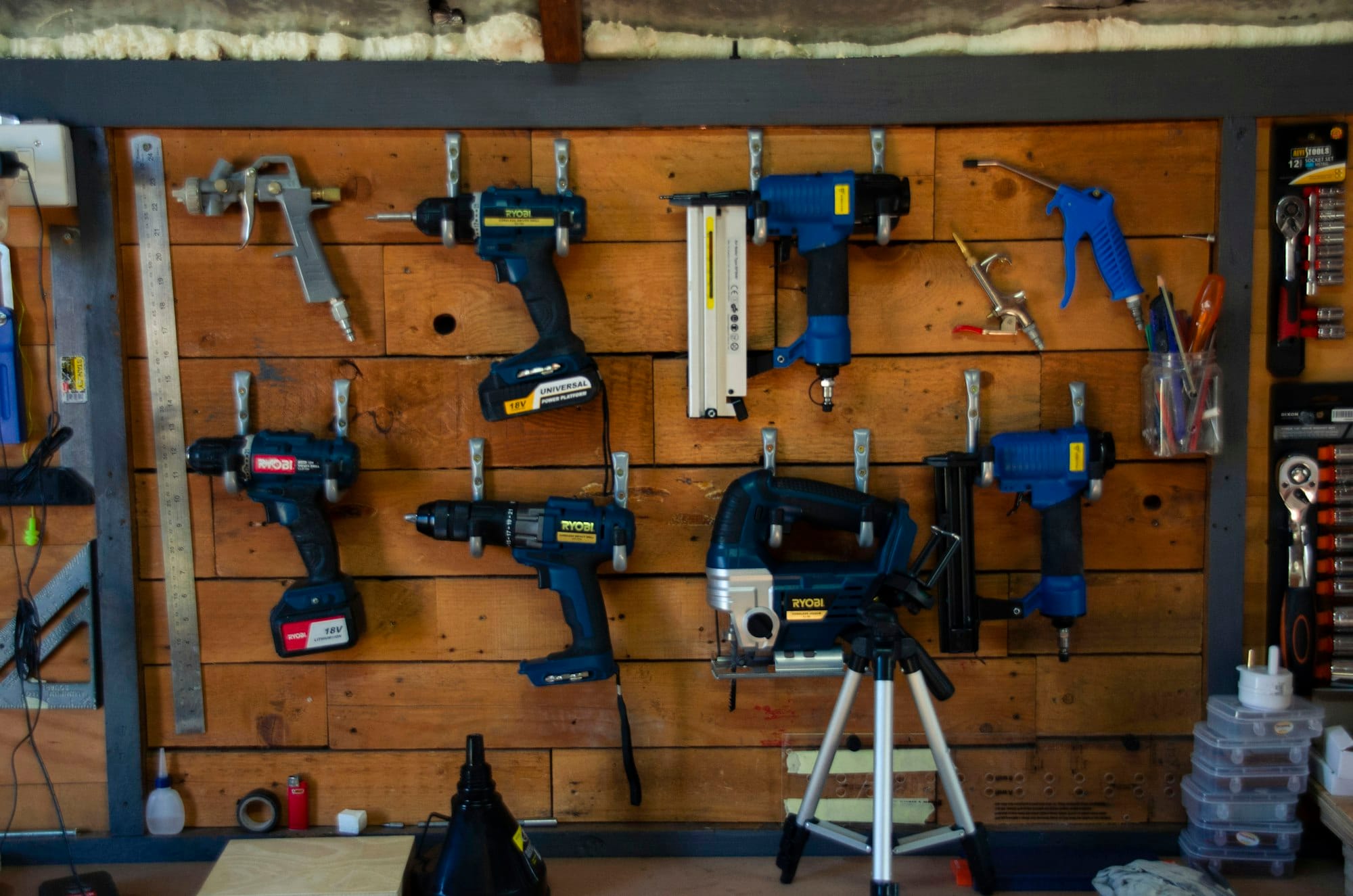
6. Ryobi (7): the staffy of power tools
Price: affordable. Platform: ONE+ 18V.
Ryobi is owned by the same parent company as Milwaukee but aimed at homeowners and DIY. The ONE+ battery fits a huge range of tools, from drills to garden gear, and it's easy to buy at Bunnings.
- Good: price, range, easy to use.
- Not so good: not built for all-day trade use, and battery life on some tools is shorter.
The best choice for new homeowners: Ryobi
If you've just moved into a new home and want tools for maintenance, hanging pictures, building shelves and looking after the garden, I'd start with Ryobi. It's affordable, the one battery runs your drill and your hedge trimmer, and you can pick up a replacement on a Saturday morning.
If you're planning serious renovation work or already have a brand's batteries, buy into that system instead. Batteries are the expensive part.
The four tools to buy first
- Drill/driver: furniture, picture hooks, curtain rods and basic carpentry.
- Circular saw: cutting timber for shelving and small repairs.
- Reciprocating saw: demolition, cutting pipe and trimming branches and shrubs.
- Oscillating multi-tool: trimming door casings, scraping paint and sanding in tight spots.
Before you drill into any wall, check for hidden pipes and cables. A cheap stud and cable detector costs less than an electrician.
Further reading
 Top 5 Best Hard Hats for Construction in 2025Gear up smart, not just tough. We break down when you need a hard hat on a construction site, explain Type I/II - Class E/G/C and compare our top 5 best hard hats for 2025.
 Best Men’s Steel-Cap Sneakers for Construction (2025)Steel-cap sneakers are changing job-site footwear. You can get rated toe protection and slip-resistant traction with the feel of a running shoe. We compare five top picks for 2025.